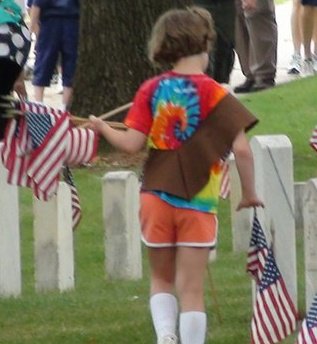
Many thanks goes out to this family….who I just happen to know…. and many others who took the time this weekend to head out to cemeteries like Marietta National to decorate the graves of our military men and women…….the original purpose behind the holiday when you go back far enough.
I have a few pictures from other Decoration Days over at History Is Elementary (follow this link) along with a mention that today’s posting is my 800th at that site.
800!!! I’m glad it could happen on such a worthy day as this.
Earlier this week I posted a history column at Douglasville Patch regarding the Douglasville/Douglas County Cultural Arts Center as well as the history of the home the organization inhabits.
Currently the CAC is exhibiting Japanese block prints spanning the 1840s to 1910. The prints are on loan from the Japanese Consulate in Atlanta.
Sometimes it’s hard to remember Atlanta is home to over 50 different consulates, trade offices and chambers of commerce representing foreign nations, but we graciously welcome our foreign friends from Cyprus, Monaco, Nicaragua, Japan and many, many others you can see here.
It’s only natural Atlanta would have an abundance of international ties since we are home to one of the nation’s busiest airports, two deep water ports, and Georgia has access to over 80 percent of the U.S. industrial market with a two-day trip by truck. There are direct flights every day to Europe, South America, and Asia making Atlanta assessable to the more than 1,000 international businesses located in our city. In recent years Atlanta has become a major banking center and 13 Fortune 500 companies designate Atlanta as their headquarters.
We have most certainly come a long way since 1837 when Atlanta was known as Terminus and was the end of the line for the Western & Atlantic railroad line.
Having been born and raised in and near Atlanta I’ve driven by the Candler Building, the building in the middle of this picture, many times, but never taken the time to really look at it.
One Sunday morning last October I found myself pushing my way through the glass revolving door at the Ritz Carlton on Peachtree blinking the sleep from my eyes and grasping my camera firmly.
I was determined to snap a few pictures along Peachtree Street. Within a two or three block distance I had taken hundreds……As you see; I have a weakness for buildings and architectural elements.
Atlanta’s Candler Building was named for Asa G. Candler, Atlanta’s 44th mayor, the man who took the Coca Cola formula and launched the company into the marketing icon it is today, and the man who is the brainchild and developer of the building in my pictures.
The building is located at 127 Peachtree Street and was built in 1906. At seventeen floors it was at the time Atlanta’s tallest and most innovative office building.
Built in the Beaux-Arts architectural style the Candler Building is also one of Atlanta’s loveliest structures. Beaux-Arts depend heavily on sculptural decoration along with flat roofs, and arched doors with pediments. The sculpture elements generally coordinate to follow along some sort of theme.
The Candler Building website states: The Candler Building's elaborately-carved facade and stunning lobby pay tribute to the world's leaders in arts and sciences. The marble busts and ornamental friezes were handcrafted by a select group of international artists. This stonework was carved from north Georgia Amicalola marble, personally selected by Mr. Candler and architect George Murphy.
This website states: Typical of the era, its exterior was visually and structural divided into three parts--a two-story base, a 12-story shaft and a three-story capital with large overhanging cornice. The interior of the Candler Building featured special floors designed for use by doctors, dentists, and surgeons; a banking hall; six passenger elevators which were "at all times under the charge of a thoroughly competent engineer"; a barbershop; and what were said to be the "finest baths in America," located in the first basement of the building. Duplicate air-cooling and electric systems were installed to reduce the chance of a total systems failure, and a building-wide "vacuum air-cleaning device" was installed. The triangular building had entrances on all three sides; the largest and most elaborate of these was on the Houston Street side and provided access to the Central Bank and Trust Corporation, which Candler organized in 1906 to occupy the lobby floor of his new skyscraper.
The interior of the building is full of marble, brass, Tiffany glass, and mahogany. In fact, the elevator cabs boast some exceptional mahogany carvings and can be seen in this video:
The Candler Building website contains some great past-present pictures of the building and surrounding neighborhood here, and this website has more images as well.
Another building in the Beaux-Arts style found in Atlanta is the Old Federal Post Office built by James Knox Taylor. Today this building is used as the 11th Circuit Court of Appeals. You can find out more about the building here.
It is my first stop when I want Georgia news. That'sJust Peachy is set up like the Drudge Report, but specifically for Georgia. It’s the one-stop shop for news and views from around the state and covers headlines from across Georgia every day.
That's Just Peachy is an attempt to help connect Georgians to issues and stories that effect their everyday lives. Content for the website is pulled from a variety of newspapers, television and radio stations, and the ever-increasing-in-importance blogging community.
Oftentimes, it is easy for the urban, suburban, and rural areas of states to forget or not realize how connected we all are and That's Just Peachy tries to synthesize these important issues into a single site.
Head on over and take a look and tell them ElementaryHistoryTeacher sent you.
That's Just Peachy has been added to the Georgia blogroll which has recently been updated and fine tuned a little.
You can find That's Just Peachy on Facebook…….and don’t forget to “like” Georgia on My Mind on Facebook as well.
I love the scene in the movie National Treasure when the Knights Templar/Freemason treasure is finally located and Ben Gates lights the room up with one flick of his torch. The river of fire glides along throughout the room up and down and all around illuminating the treasure indicating just how many things await discovery. That stream of fire just seems to keep going on forever and ever.
At that point all I can think of is how wonderful it would be to have the task of taking each item bit by bit into the daylight, dusting it off, and identifying where it belongs in our historical story.
I can dream, can’t I? Isn’t that the purpose of going to the movies? To escape into a story and imagine your life intertwined with the story’s events?
Look at the picture below…..
Doesn’t it remind you of the pictures of King Tutankhamen’s tomb prior to it being unpacked by Howard Carter in 1922?
King Tut’s tomb was not packed full of treasure. The purpose behind his tomb was to provide him with items he would need in the afterlife. The people who packed the tomb had no idea we would consider it a treasure.
The picture I’ve shown above does show a treasure of sorts, but it is an intentional treasure… the contents of a time capsule. Items man has set aside for men of the future to examine and analyze, so that there will be few unanswered questions regarding how we lived.
The words “time” and “ capsule” were first used together in 1939 by George Edward Pendray, an American public relations counselor, author, foundation executive, and an early advocate of rockets and spaceflight. He created a “time capsule” as a public relations stunt for Westinghouse at the 1939 New York World’s Fair, and the practice of setting aside certain items for folks in a future time to stuck in the American psyche.
The picture posted above shows the contents of a time capsule that was officially sealed in 1940 and is located in Atlanta, Georgia on the campus of Oglethorpe University.
The Oglethorpe capsule is known as The Crypt of Civilization. Pendray received his inspiration for the New York World’s Fair capsule after reading about the plans for the Crypt of Civilization.
Ever hear of Thornwell Jacobs? I doubt it. He was an educator, author, and a Presbyterian minister. He was also the president of Atlanta’s Oglethorpe University for 30 years beginning in 1915.
He also implemented the Crypt of Civilization. A Scientific American article from 1936 discusses Jacob’s ideas. Jacobs wrote of a unique plan to present a “running story” of life and customs. He wanted to show the accumulated knowledge of mankind up until his time.
The 1990 Guinness Book of Records calls the Crypt of Civilization the first successful implementation of the modern time capsule.
The Crypt page at the Oglethorpe University webpage can be found here.
The contents of the crypt include items donated from King Gustav V of Sweden, classical works such as the Bible, the Koran, and Dante’s Inferno. An original script for Gone With the Wind along with recordings of Hitler, Stalin, Mussolini, and Roosevelt. Sound clips from Popeye the Sailor and a champion hog caller were included.
Everyday items like dental floss, the contents of a woman’s purse, a pacifier, and a set of Lincoln Log are included. Microreaders and projectors are included so that the films and recordings can be accessed along with a windmill operated generator since current forms of electricity might not be in use in 8113 AD.
It is scheduled to be opened in 8113 A.D. Yes, I know. The proposed opening date brings several questions to mind such as will the Crypt be forgotten? Will it be lost to time? Will it matter to folks living in Georgia and the world in 8113 A.D?
Apparently the folks at the History Channel had the same questions making the Crypt of Civilization a focal point of their series…….Life After People.
Here is the first section of the series where it mentions the Cyrpt:
It is mentioned again at the end of Part 4 found here.
The International Time Capsule Society is also at Oglethorpe University. Their mission is to promote the study of time capsules. Their mission states: To maintain a registry of timed events of all known time capsules, to establish a clearing house for information about time capsules, to encourage study of history, variety and motivation behind time capsule projects, amd to educate the general public and the academic commumity concerning the value of time capsules.
The city of Douglasville has a time capsule buried on the “old” courthouse grounds.The capsule will be opened in 2070, but you can find out what’s in it at this link.
If you look up the definition of the word “patch” you discover a patch is something that covers or mends a small area. Synonyms for the word patch include cover or reinforcement.
The definition and synonyms can also apply to the Patch website found here.
Patch is the new online new source that covers a specific area and serves as a reinforcement regarding the news you need to know.
The Patch website is a link to various Patch sites quickly covering towns and cities all across the United States as evidenced by the map found at the Patch webpage.
Click on the state of Georgia and you can quickly see Patch is on the move across the Atlanta metro area and beyond covering cities and town such as Buckhead, Kennesaw, Holly Springs-Hickory Flat, and even my town of Douglasville.
The Patch page advises, “Simply put, Patch is a new way to find out about, and participate in, what’s going on near you.”
The information is community-specific, and the platform provided is news and information including events, photos, videos, and information about local businesses and schools. You can participate in discussions and even submit your own announcements, photos, and reviews. The site for your town is completely interactive.
Recently CBS News presented a short video package regarding Patch. You can see it here.
The image seen here is the official seal of Georgia.
Seriously…..it is.
Really.
Would I kid you?
I’m sure you have questions.
Questions such as…where is the arch with three pillars representing the three branches of government draped with the words “wisdom”, “justice” and “moderation”? Where is the soldier standing with his sword drawn? Where are the words “State of Georgia” and the year “1776”?
The image seen here is NOT the seal of the state of Georgia but it IS the seal of the Georgia colony and was used by the Trustees of the colony.
The Georgia Historical Society states, “The seal used by the Trustees represented the colony's role within the British Empire, as well as its emphasis on the production of silk. The seal, seen in the above sketch, incorporated a black mulberry leaf with a silkworm and cocoon (mulberry leaves were used to feed the silkworms in sericulture, the cultivation of silk). The motto inscribed was "Non sibi sed aliis," Latin for "Not for themselves but for others." The seal and motto are a symbol of Georgia's role as a mercantile colony established to be the source of silk, not for their own benefit, but for England's. “
Most Georgia history students are taught that due to the colony’s warm climate and southern location many felt it was the perfect location for the cultivation of silk. They are also taught that eventually the manufacturing of silk failed and other crops became more important like cotton. Usually, the silk industry in early Georgia is just a blip on the history map…..a mention lasting about ten minutes at the most.
That’s it…..a short little paragraph for students to grasp.
Well…..there’s more to the story.
The silk industry in Georgia began in 1734 with some experimental plantings of mulberry trees in the Trustee’s Garden in Savannah. The trees were planted because silk worms live off of the mulberry leaves. In fact, the cultivation of silk was so important all Georgia colonists were required to plant mulberry trees once they took possession of their plot of land.
After a few months the colonist had to admit there were significant issues regarding the silk worms themselves. The whole process was labor intensive. The Trustees decided the colonist who had been hired to manufacture the silk needed some expert advised so they invited an Italian contingent to the colony to teach them the ins and outs of manufacturing silk, but there were constant issues between the Italians and the “Georgians.”
In fact, an Italian skilled in the production of silk named Paul Amatis accompanied Oglethorpe to Georgia in 1732, and another Italian named Joseph Ottolenghe was responsible for erecting a filature at Reynolds Square, located on Abercorn between Bryan and Congress Streets. A filature is a structure used to house cocoons and where silk is reeled. The filature at Reynolds Square held a record number of 15,212 pounds of cocoons.
John Milledge was assigned a grant of land located on Skidaway Island sometime between 1754 and 1771 where he named his plantation Modena, supposedly after an Italian town that was the center of the silk culture. Milledge’s son, John, Jr., became the founder of Franklin College which eventually morphed into the University of Georgia.
Apparently, it didn’t take long for the Georgians to have some success with actual fabric being produced as James Oglethorpe was able to supply the wife of King George II, Caroline, enough silk for a gown she wore to the King’s birthday celebration in 1735.
I would love to write I was able to locate a painting of Queen Caroline wearing Georgia silk, but at this point I can only speculate. I did find a painting she commissioned by Jacopo Amigoni (Giacomo Amiconi) in1735….the same year she reportedly wore the dress created from Georgia silk. The cape the Queen is wearing in the painting is actually a state robe trimmed in ermine, however, the dress she is wearing could very well be the dress she wore for the King’s celebration and was made entirely of Georgia silk.
By 1742 enough silk was being produced for it to be a commodity and records show by 1767, a ton of silk was being exported each year.
The Salzburger colonists outside of Savannah were also experimenting with silk and had even more success than those in Savannah. One woman in the community was quite successful creating silk for fishing lines.
Eventually the industry could not overcome the ups and downs in the Georgia climate, and cotton proved to be a far easier and more economical crop to produce.
Even so silk didn’t just go by the wayside. It was still around in the 1830s as far inland as Cherokee County. In fact, the state of Georgia historical marker at the square in front of the courthouse states, “Early settlers tried to start silk production, but were not successful, and today there remains no trace of this except Canton, hopefully named for the Chinese silk center.
At that point silk then just became a chapter in the Georgia history books.