Google+ Georgia On My Mind: Atlanta
Showing posts with label Atlanta. Show all posts

Monday, January 27, 2014

The Murder of Sarah Collins


When thinking about past events it is easy to speed up time. For example, several events occurring over a few weeks can be interpreted in just a few days especially once they hit the movie screen.

Atlanta's involvement in the Civil War is one such example, and I blame the movie….not the book….Gone with the Wind for the "speedy" version most people have in their minds.

We see Aunt Pittypat upset because Yankees have reached Georgia as she is evacuating the city. The Battle of Atlanta occurs, Miss Melly has her baby and that scoundrel Sherman burns the town.
What a day!

However, those events occurred over several weeks.
The Battle of Atlanta occurred on July 22, 1864 with the Rebels retreating from the city.

The Mayor of Atlanta didn't surrender the city to the Union until September 2, 1864 following a five week siege.
Five long weeks….

While there were some heart wrenching events during those weeks of siege many folks in the city of Atlanta tried to get on with some semblance of normalcy.
In his book, The Bonfire: The Siege and Burning of Atlanta, Marc Josef Wortman states, "Thumbing their collective rebel noses at Sherman amid the siege, Atlanta's party life went blithely on. Distillers sold corn whiskey to soldiers, and prostitutes serviced the troops behind the lines. Officers went to festive balls, where bands played while fiery exploding shells passed overhead."

One such ball was given by the Atlanta Medical College on August 12, 1864 just twenty-one days after the Battle of Atlanta.
The Atlanta Medical College would eventually become Emory University's School of Medicine. The picture I've posted above is the school as it appeared in 1957. This image is a drawing that appeared in the Illustrated History of Atlanta by Edward Young Clarke.

I'm uncertain as to why the school decided to give a ball during the siege of Atlanta since they had suspended lectures on July 3rd, but they did.

One of the young ladies who attended the ball happened to be Sarah Collins, a woman described as beautiful and held a "high position in the first circles of the city."
Sarah had arrived in Atlanta a year earlier as a refugee from Memphis.

The Medical College ball would be her last event.
In the midst of war in a city that was under siege, Sarah was murdered.

The newspaper at the time....the Daily Intelligencer reported the murder of Sarah Collins describing the event as "the most horrible crime that has ever been committed in [the city of Atlanta]." She was found strangled in her bed. The Daily Intelligencer reported "her throat was perfectly black where she had been choked, her arms were bruised, and her body terribly mutilated; her clothing was torn and muddy as though she had been drug through the mud by some villain who had violated her person."
Unfortunately, due to the chaos of the times with no real law enforcement no one was ever brought to justice for the murder of Sarah Collins.

To my knowledge the murder remains an unsolved crime with very little written about it other than the article that appeared in the Daily Intelligencer during August, 1864 and a mention here and there in various books.

Monday, January 20, 2014

Atlanta by Gaslight

People lament all the time that the old Atlanta is gone – torn down, built over, swept away and forgotten.

I think the past is still with us in a tangible way such as the Tullie Smith house or the Wren’s Nest, but yes – sometimes we do have to be satisfied with historical memories via the written word or images presenting places long gone like the grand mansions that lined Peachtree Street once upon a time.
Then there ARE those situations where bits and pieces remain.

I find those fragments of history to be the most fascinating because they hide in the contemporary landscape with most never realizing they are passing a gateway to Atlanta’s past each and every day.
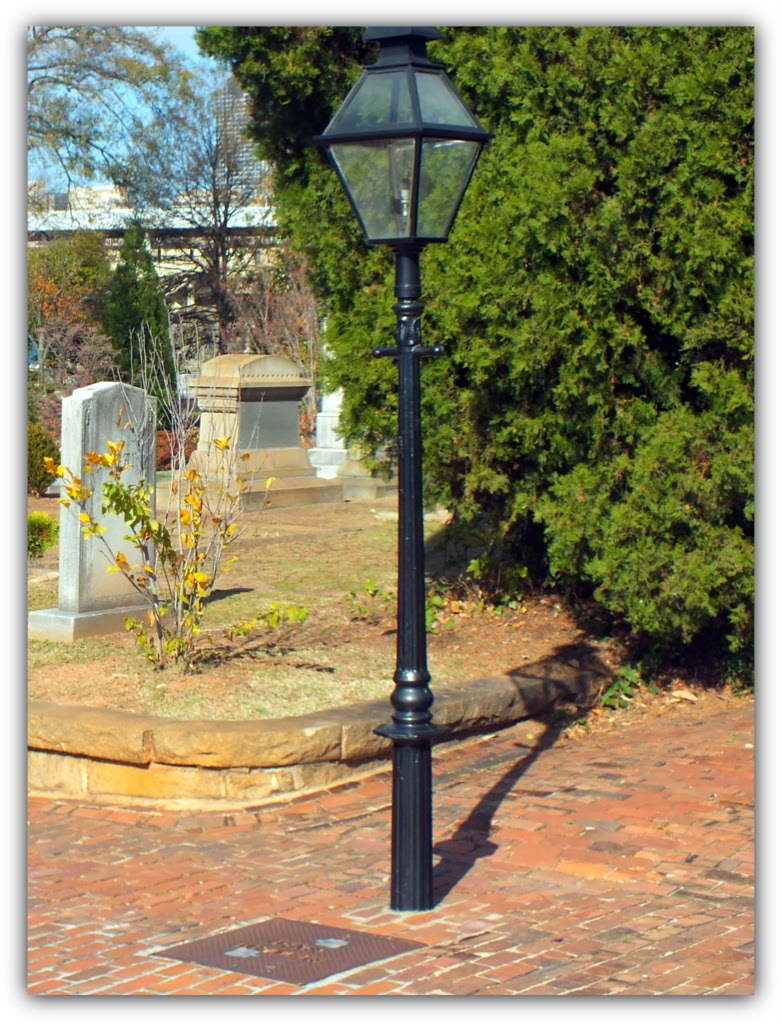
Take the three streetlights that stand in Piedmont Park near Park Drive Bridge, for example.

The streetlights stand as a testament to Atlanta’s history dating back to 1916 when the lights were placed in the park in remembrance of the Gate City’s proud history. 
That’s something isn’t it? Items still standing that date back to 1916.

But wait – there’s more.
The light poles actually date to 1855 when they were ordered from the Schofield Iron Works of Macon at a cost of twenty-one dollars each. The granite bases for the three poles were taken from some of the first pavement, or what existed as pavement, at the time in the city.

Originally the poles were topped with gas lamps and were installed along an Atlanta street by the Atlanta Gasworks. Today we know the company as the Atlanta Gas Light Company, the oldest corporation in the city and second oldest in the state.
Today’s news reports advise some of the streets in Atlanta are dangerous at night, but in 1855 the reasons were very different. Livestock roamed the streets and some of the pothole situations were described as virtual pits that someone could stumble into if they were wandering around in the dark.

The young city had been interested in the new technology of gas lamps but cost was a factor. A couple of proposals were made for a city gasworks, but the city council waited.
Finally, William E. Helme made his proposal. He was a businessman from Philadelphia who had installed the gasworks for the city of Augusta. He along with his partner, McIlhenny had patented gas meters and other equipment. You can find out more about McIlhenny here.

Apparently, dabbling in the gas works industry was very lucrative. This is the Helme home near Philadelphia in Lancaster, Pennsylvania. It sat on eleven acres at Pike and St. David’s Road.
 
We must remember that in the early days, natural gas had not yet been harnessed for energy purposes. The plant Helme proposed to build would be one that burned coal in order to produce the gas.

The plant would cost $50,000. His exclusive contract was for a period of fifty years, and fifty street lamps would be provided initially at $30 per annum. 
Helme set to work laying the first three miles of pipe for the gas. Atlanta's citizens celebrated on December 25, 1855 when the first gas lamps were lit.

The gasworks company and the shareholders earned handsome dividends over time.
During the Civil War the city took over the company. Since Helme and many of the shareholders were Northerners, they were declared “alien enemies”. The seized shares were soon auctioned off to folks of the Confederate persuasion.

However, Helme and his investors weren’t the Yankees the city council should have been concerned with since it was General Sherman who ordered the Gas Works to be burned in 1864.
Following the war it took a while, but by 1880 all of the city’s lamps were lit again, and by 1881 the city converted all 426 gas lamps into electric ones.
One of the lamp posts can be seen at Oakland Cemetery as seen below (photo credit: Robert Lz/Flicker)
 
You can view pictures of one of the three Piedmont Park lamps mentioned above at History Atlanta, one of my new blog finds that I ADORE here.  Fantastic site and great scholarly research!

Tuesday, August 20, 2013

A Clubhouse for Bobby

Way back in 1896 a group of men formed a club to honor their favorite poet, and by 1907 they wanted to build a clubhouse.

What else is new, right? It begins in childhood – groups of boys want a hut or a fort excluding the girls so they can go about their “guy” business without any bossing from the females.  Just because the boys grow up doesn’t mean they are over the fact that they want “boy” time.
The Burns Club of Atlanta was no different. It was men’s only club, and they needed a permanent place to meet all their own.

Club member Joseph Jacobs of Jacob’s drugstore fame told the members if they found a suitable plot of land he would make the purchase, and over time the club could pay him back.  Mr. Jacobs had a little income due to a successful drugstore, and it was Jacobs who had made the suggestion to add a little carbonation to some newfangled drink called Coca-Cola.

The club had been meeting around Atlanta in various hotels. They wanted to find a place that was outside the city, but still close enough in that they could catch the last train after dinner to head home.
They finally found ten acres off Confederate Avenue in the Ormewood Park area, a suburb of Atlanta that was originally developed in 1892.  It’s a little hard to wrap my head around the idea that Ormewood Park was not in the city of Atlanta, but during the early 20th century it wasn’t.

The club members set about building a replica of a cottage in Alloway, Ayrshire, Scotland which happened to be the home of Robert Burns, the 19th century poet the club members honored.
Come on, you remember Robert Burns from your high school and college literature courses, right?  Burns is famous for poetic lines such as, “O my Luve’s like a red, red rose, That’s newly sprung in June…” and every New Year’s Eve we all remember Burns when we sing the lyrics to Auld Lang Syne

Club member Thomas H. Morgan, an architect set to work on building a clubhouse that was an exact replica of the Burns’ home in Scotland.
This website states…..

The interior of the house is also a close replica of the Scottish cottage, and was divided into the traditional four areas: but, ben, barn, and byre. At the far end is the but, which would have been the kitchen, dining room, and parents' bedroom. Next to the but is the ben, which would have served as the living room and childrens' bedroom. These two rooms are decorated with memorabilia from the life of Robert Burns. The assembly room, which replaces the barn and byre, is used for club meetings. The three fireplaces in the cottage are constructed of random stones with mortar joints raised and rounded. The fireplace in the center of the cottage has an inset stone plaque in memory of the poet. The only remaining outbuilding is a one-story stone caretaker's house, originally a log cabin. It was redesigned in 1969 to bear a closer resemblance to the cottage. The grounds once covered 10 acres and included a dance pavilion, barbeque pit and shed, a tennis court and putting green for club use and for rental to other groups. Changes to Burns Cottage include the rear addition of small, functional kitchen, porch and restrooms. The assembly room's original stone-flagged floor was replaced with a concrete one, a fireplace was added at the far end, and some of the small windows were closed.
Early on the cabin had a thatched roof, but eventually the Fire Marshall determined the roof should be replaced.

Since the clubhouse was finished in 1911 the Burns Club of Atlanta has used the building for their meetings. Once a year on January 25th they hold a special super to celebrate Robert Burns’ birth.
The Burns Club of Atlanta is said to be the city’s oldest continuing social, literacy and cultural organization. The club is private. There are no tours. The only way I could attend a dinner or meeting is if I’m invited by a member.

So, are there any members out there?
 The photograph with this post is used via the Tracy O'Neal Photography Collection at Georgia State University Library. It dates to 1944

Tuesday, July 23, 2013

Atlanta Pioneer: Er Lawshe

Some months ago my husband and I took a little field trip over to the Atlanta Zoo. While there we visited the Cyclorama, too. Walking through the exhibits I noticed a picture of this house.


The Lawshe House.

I came home, downloaded the pictures and meant to refresh my memory regarding the Lawshe family and their home, but forgot....until now.

The home, built in 1859, sat on the west side of Peachtree one lot north of Cain Street. It's a classic for the time period with porches on both levels.

Er Lawshe (yes, that's his real name) came South from Lewisburg, Pennsylvania with two of his brothers in 1848. Lawshe had apprenticed as a cabinetmaker in Philadelphia. When arrived in Atlanta he had $7.25 in his pocket.

The picture below shows Mr. Lawshe with his bride, Sarah.


Originally, Lawshe partnered with Riley Baker in a jewelry business selling watches and other items. Later he struck out on his own and was very successful to the point he was able to build the fine two-story home at 224 Peachtree Street which adjoined property owned by his in-laws.

During the Civil War Er Lawshe fought for Confederacy meaning that he was actually fighting against many of his family members. The Lawshe family left Atlanta in February, 1865 and headed to Augusta leaving their home basically abandoned as so many others. This made many of Atlanta's fine Peachtree Street mansions readily available for Union officers once they entered the city, and the Lawshe home was no different.

Brigadier General Felix Salm-Salm and his wife Agnes arrived in Atlanta on July 7, 1865 and chose the Lawshe home to live while he was in command of the Atlanta post. Salm-Salm was a  rather colorful fellow. He was from Westphalia, Prussia and was actually a prince of royal blood. He had served in the Prussian cavalry and once the Civil War broke out he joined the Union where he was commissioned in the 8th New York regiment. His wife was an American - the former Agnes Clerq of Baltimore. She was so in love with her husband she never wanted to be apart from him. Agnes would actually join him on the battlefield. She shocked Atlantans by riding through town astride her horse rather than sidesaddle as ladies of good breeding did at the time, but it is said she showed sympathy and compassion for the folks of Atlanta while she was here. They entertained at the Lawshe home by giving simple dinners and teas before leaving the city in October, 1865. 

When the Lawshe family returned following the end of the war Atlanta was of course in ruins, but their home was one of just a few still standing. Lawshe would not replace the boards that clearly showed shell damage.

Er Lawshe set about rebuilding his business at 47 Whitehall, but since there were no materials he resorted to using some of items Union soldiers had used to construct huts with while the city was occupied. In some cases the materials were just debris. Later when he was able he built a three-story brick building on the site of the store.

Er Lawshe also wrote various stories for The Atlanta Constitution later in his life. He was very well thought of in Atlanta and many claimed this was due to his integrity so much so he earned the nickname "Old Reliable".

After Lawshe passed away his home was sold for $18,000 to the Gate City Guards where they would eventually build their armory.

Wednesday, June 26, 2013

Wordless: Atlanta Airport


It's been many weeks since I participated in Wordless Wednesday.  This picture of the Atlanta airport as I remember it when I was a little girl prompted me to participate.

You can like Georgia on my Mind's Facebook page here.

Find other bloggers participating in Wordless Wednesday here.

Monday, June 17, 2013

The Tuttle

Think about this for a minute...

What would happen if a rock formation in the shape of an eagle was discovered on a construction site?

Construction would stop, all sorts of experts would be called, groups would protest, the rock  formation would receive its own Facebook page and most certainly mention of it would be found in the newspaper, right?

Apparently, finding a rock formation resembling an eagle during construction of a Federal courthouse and post office in 1907 wasn't a big enough deal to make the papers because I can't find one mention of it...anywhere.

Insert a heavy sigh here.

Atlanta has "The TED" referencing Turner Stadium, but we also have "The Tuttle".

Yes, "The Tuttle"...found at 56 Forsyth Street.


I'm referring to the building above that houses the Eleventh Circuit Court of Appeals renamed in 1981 to honor Elbert Parr Tuttle, an Atlanta  judge known for the large amount of pro bono civil rights work he handled during his legal career. Tuttle was awarded the Presidential Medal of Freedom in 1981 for his Civil Rights work.
The building itself has been the location of several important cases through recent years including the Elian Gonzales case and at least two of the decisions regarding Bush v. Gore were decided within the walls of the Tuttle building.
Also known as the U.S. Post Office and Courthouse from years past, the five-story building is huge. It occupies the block bordered by Forsyth, Fairlie, Poplar, and Walton Streets.
In 1907, Atlanta had grown to such proportions a new federal courthouse and post office was needed. Congress appropriated the money and on July 23, 1907 folks in Atlanta viewed this drawing of their million dollar plus courthouse on the front page of The Atlanta Constitution.


Architecturally, the building follows the Second Renaissance Revival style. Some windows contain carved serpent-and-staff designs associated with Mercury, the Roman messenger god - an early symbol used by the postal service.


A mural decorates the lobby portraying an allegorical Justice flanked by Industry and Agriculture.


The carved oak panels throughout the building are decorated with garlands, scrolled brackets and molding.


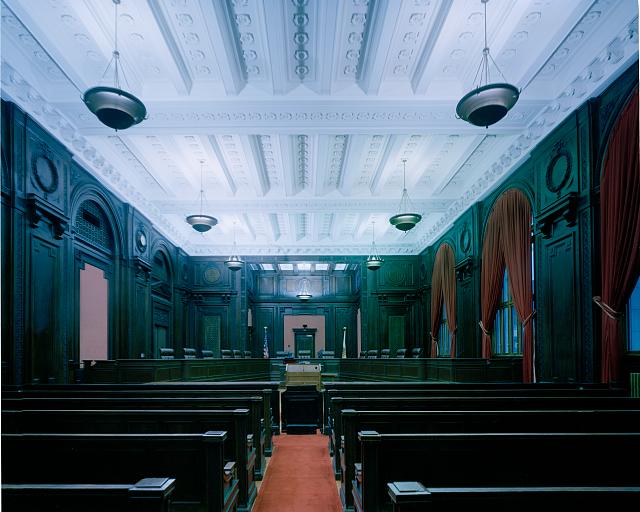
....and of course the courtrooms are magnificent with detail. Unfortunately,I don't think someone will be writing about many of the courtrooms of today one hundred years from now. They just don't capture the attention as buildings such as "The Tuttle".


James Knox Taylor, the supervising architect of the U.S. Treasury designed the building with ground being broken in 1906. As I read about the building the most amazing thing I found was a natural rock formation resembling an American Bald Eagle was discovered as the building's foundation was dug. Apparently, folks involved decided since it was a symbol of our country, it was a sign that the proper site had been chosen for a Federal building.

I've scoured the papers during the years of construction - 1906 to 1910 - and can't find a mention of the discovery.

Was this just some natural fluke in the topography of the site?

Was this evidence of Native Americans in the area?

Should it have been preserved?

Seriously....Why can't I find any further mention of the formation?

Sometimes, I can't find the answers I'm searching for, and it's very frustrating.

Pictures courtesy of the Library of Congress.

Wednesday, April 17, 2013

Atlanta's Historic Row Houses

My parents periodically had out of state friends visit us, and of course, we always took them to see the sites. In the late 1960s and 70s the sites included the Varsity, a trip to the airport to watch planes take off and land, and we would have been considered poor hosts if we didn't take folks down to Tenth and Fourteenth Streets to gawk at the Hippies.

Apparently, Atlanta has always had certain must-see sites to show out of town guests. I found this quote from a former governor, John M. Slaton who recalled that in the 90s --that would be the 1890s -- one always took visitors to see the state capitol building, Lithia Springs and Baltimore Block.

Well, I can certainly understand the draw of the state capitol especially if they had the two-headed calf on display back then, and since I research and write about Douglas County I can even understand the draw of Lithia Springs in the 1890s. If you don't, then read this, but what about Baltimore Block?

What the heck was that?

Look at this grand mansion in the picture I've posted below (photo courtesy of the Atlanta History Center).


This is the mansion of Calvin W. Hunnicutt. It's a view of his home via a side street that at the time was known as Hunnicutt Avenue.

Makes sense, right?

Hunnicutt's home sat along Spring Street, and he owned various parcels of land including the land along Hunnicutt Avenue.

At the time the area where Hunicutt lived was very fashionable. It was considered the northern end of the city. In fact, Tenth Street was the dropping off point, since anything past Tenth was farmland, and the roads steadily got worse.

In 1885, along came a company by the name of Atlanta Land and Annuity Company owned by a group of businessmen from Baltimore led by Jacob Rosenthal. They bought the land along Hunicutt Avenue for $22,000 and built 14 townhomes - the first type of apartment homes in Atlanta. Amazingly, 8 of the homes still exist!

In the tradition of Baltimore row houses Rosenthal built homes that appealed to the folks in Atlanta because they were different. Of course, the homes didn't spread out. They were taller than they were wide rising to a height of three floors. Each home had a depth of 70 feet, 1 bath, and a kitchen on the basement floor. The homes boasted the first central heating system in Atlanta. Known as a Baltimore heater it was fitted into the fireplace on the first floor with vents running  to the upper floors.

Of course, Hunnicutt Avenue soon became known as Baltimore Block, and it became one of THE places to live in Atlanta or at least to be seen. During the late 1800s ladies would have social gatherings called "at homes", and to be invited to an "at home" on the Baltimore Block meant you had "arrived." There are also stories of fantastic New Year's Eve parties on the block as well. Another draw was the street itself. It was cobblestone, and added to the unique look of the block.

There were other draws to the property such as the fantastic recessed doorways.


The Baltimore Block homes were also unique in that it was based on the first long-term lease ever consummated in Atlanta. You could purchase one of the homes for $4,000 and take on the responsibility for the taxes, upkeep, etc., but the interesting part of the deal was owners actually leased the land from the Atlanta Land and Annuity Company.

In his book Atlanta and Its Environs Franklin Garrett explains that the "arrangement was quite complicated for those days of straight sales."

Once the purchaser agreed to pay $4,000 for the home he then leased the ground occupied by the building for a term of 99 years at the annual rental of $110 each. This brought the company an annual return of $1,540 on its original investment.

Take another look at the picture I posted above of the Hunnicutt mansion. At the time the picture was taken the row houses had already been built. You can make them out a little in the picture, but here is a better one.


Unfortunately, by 1908 popularity of the Baltimore Block had waned as the fashionable people moved further north, and for a few years the area declined. Four of the units were torn down in 1924.

By the 1930s, the block was run-down and home to vagrants, but a new crowd began to move in.

Folks like Harvey M. Smith, Jr. moved into 17 Baltimore Place. Known for many things including being a close friend of Margaret Mitchell, Mr. Smith published Southern Architectural Review.

Other notable residents during that time were Mr. and Mrs. William Hunter. They moved to Atlanta from Pennsylvania and bought unit 13. Some of the regulars in the neighborhood weren't too happy about that. See, they bought the one unit on the block that had a missing front door. Folks had been using the unit as a walk-through from one side of the block to the other. Mr. Hunter was a landscape architect, and Mrs. Hunter collected antiques.

It was the Hunters who were the long hold-outs during a push by Asa G. Candler to purchase the entire block for a medical complex he wanted to build. Since the Hunter's wouldn't sell the deal fell through. Mr. Candler had to go elsewhere for his building which happened to be Crawford Long Hospital. 

Another notable to the Baltimore Block re-birth was Nancy Barrington Dolinoff de Welles, sometimes referred to as the Countess. She was born in Mobile, Alabama, but if you are familiar with Roswell she was one of the Barringtons of Barrington Hall. The Countess was in Paris at the beginning of World War II. She fled to the United States shipping everything in sections. She took over units 15, 17 and 19 along the block making a very nice home for her and her two daughters.
The picture below is from 1939 along the block during the celebrations across the city of the premier of Gone With the Wind.


By the 1960s another change came to Baltimore Block as the row houses became home to Atlanta's Beat Generation -- a center of counterculture.

At one point a developer came in and wanted to redevelop the block, but again one lone holdout kept the project from happening Property owner Isobel Hunter Quentin put her foot down and wouldn't sell.

You guessed it...she was the daughter of the Hunters who some years before wouldn't see to their unit to Asa G. Candler.

...and it's a good thing. I'm glad she waited for E.R. Howington & Associates to come along. In the late 1980s they bought the block and renovated it into office space. The block is now joined by a glass-roofed atrium to an addition in the back featuring a high rise with more office space and several penthouse apartments.

Today Baltimore Block is part of Atlanta's SoNo District.

SoNo? Yes, the area of town south of North Avenue -- a name the area has held since 2005 when folks decided they wanted a trendy name, but you know what?

I don't think SoNo makes the area trendy. I think it has something to do with the history of the area. The ebb and flow of a block where many different people lived for over a hundred years.

The history of Baltimore Block is the draw, and I'm awfully glad it's still around even if it is a different form from the original.

This PDF file has numerous newspaper and magazine articles concerning Baltimore Block through the years. I lost myself in all forty-something pages last night for several hours.

Monday, November 5, 2012

The Election of 1884


Well, the long road to the Election of 2012 is over, and tomorrow evening we should know who the next occupant of the White House will be.  

I spent some time yesterday wondering how Atlanta reacted to past elections, and I found an interesting account from the Election of 1884 including revelry that lasted all day and night as well as citizens bursting into the General Assembly while in session and a river of fire ran through the city's streets.

Read on...it's not what you think.

You may rely absolutely on Cleveland's election....

Once those words were sent out to cities all over the United States via telegraph the Election of 1884 was over.

Grover Cleveland would be heading to the White House.

Franklin Garrett, Atlanta's premier historian advised in his book Atlanta and Its Environs......In ten minutes 1000 democrats were in consultation as to how best to celebrate. Mr. Henry W. Grady was elected marshal of the day. Committees on music, bloody shirts, bonfires and parade were appointed and at 10:30 there were over 3000 men in line.

The Constitution for November 8, 1884 stated the following:

In front of the procession were two volunteer drummers, Gresham and Brown. Following them, leading the line of march came Mr. Grady, his hat wrapped with a new silk flag, and Alderman Lowery bearing an immense flag, which was greeted with resounding cheers.....

Next came the bloody shirt brigade....bearing red shirts stretched on crossed poles.  Affixed to each shirt was a placard reading, 'We are going to burn this!'

The bloody shirt made reference to instances during the campaigns where reference had been made to martyrs in exchange for political points.

The newspaper account continues:

Behind the bloody shirts came about a thousand men bearing small flags. Next to these was a huge United States flag stretched as a canopy over 50 men in charge of Jim Iverson, Hoke Smith and Dr. [Clinton T.] Brockett......

As the procession marched up Broad Street it was met by Hon. E.P. Howell and Major John Fitten with a brass band they had picked up in a jiffy. They had gathered perhaps 500 people, who at once fell into the column, the band taking its place in the center. As the march proceeded up Broad it was greeted by cheers from the crowd that lined each side of the way and filled all of the windows. Up Marietta Street it was the same.

On reaching the capitol the line of march was turned into the side steps and up into the corridor it poured like a torrent.  When they reached the door of the house, the drummer started in. The doorkeeper made some show at holding the doors, but Mr. Evan Howell bracing against the brass drum pushed in and the crowd followed with a rush.

The house was in session. The drums were stilled, and the members in surprise rose to their feet.

Mr. Grady with beaming face announced:

'Mr. Speaker! A message from the American people:'

The house rose as one man this time, and the column marched onto the speaker's stand, with drums beating and colors flying. Hon. Lucius Lamar was in the speaker's desk. Mr. Grady siezed him in his arms, and took gavel from his hands, and rapping for order said:

'in the name of, and by the authority of Grover Cleveland, President of the United States, I now declare this house adjourned until tomorrow morning at 10 o'clock!"

The house took the point like a flash. Most of the members were on their desks, the uproar and cheering were terrific. The speaker took the stand and tried to restore order, but the thing was over. A resolution was offered by Mr. Flint of Spalding congratulating Cleveland and Hendricks. It was voted on by 2000 people, who filled every nook and corner of the house. There were calls for 'Grady' for several minutes but he had left to adjourn the senate and the governor.....

....in front of the capitol the broad streets were packed with 10,000 people shouting themselves hoarse. The bands were playing 'Dixie' and the yelling was deafening. Governor McDaniel was brought down accompanied by General Lawton. They were received with cheers and encircled with United States flags. Mr. Grady then announced that Governor McDaniel would address the unterrified and jubilant democracy of Fulton County from the customhouse steps.

The bloody shirts, saturated with oil were fired in front of the capitol and burned amid the wildest demonstrations of joy and approval. When this interesting ceremony was over, Mr. Grady introduced Governor McDaniel......

Over a thousand torches were provided and at six o'clock a remarkable scene was presented about the Constitution building and for blocks around. Everywhere the weird light of the torches could be seen and the streets were filled with crackling bonfires, until the picture was like unto a view of the infernal region. Everywhere was one moving mass, while shouts rent the air and horns shrieked and drums beat and bands played. It was a wild scene and one that was calculated to fill the stoniest soul with patriotic enthusiasm.

At seven o'clock the procession started, led by a detachment of sixteen mounted policemen to clear the way. Following came young men from the Democratic League, about 300 strong, bearing [signs]. The greatest procession, to the music of 'Dixie', turned into Broad Street and proceeded toward Mitchell......Broad Street seemed like one mass of moving fire, and a wild pandemonium of exultant democratic noise.....Along Whitehall were brillant illuminations and thousands of flags fluttered gaily, while every few feet bonfires and colored lights made a scene that was as dazzling in its brilliance....

....As the procession passed along Whitehall, it was easy to see how imposing it was. Among the [signs that the people carried were the slogans]: Low tariff and reform, Paint the town Red, .....and Tell the Truth....

....At the Constitution office the procession was reinforced, and again they started out passing around Broad, Mitchell and Whitehall again.....Everywhere immense bonfires were burning, rockets and Roman candles were firing and the scene was a wild one....

....The procession turned into Peachtree, and then a scene of grandest brilliance occurred. The procession by this time was nearly a mile and half long and the thousands of torches looked like a river of fire that flowed along the ridge lined by the bank of trees. The residences were brightly illuminated. The Capital City Club was brilliant as a palace and the lawn of Leyden House was filled with a thousand Chinese lanterns, while the building was lighted by hundreds and hundreds of candles, making it a blaze of light.......

....By the time the procession turned into Peachtree there were fully 25,000 people on the streets. Never in the history of the city were there so many people out at one time. 

[At one point] the procession was joined by the Gate City Guard under command of Captain Jackson. The procession turned in Forsyth Street and proceeded to the customhouse, halting in front of the building and filling Marietta Street with a sea of fire for blocks each way.

For some time the horns tooted, the bands played, the drums beat, the populace shouted, the cannons boomed and there was a regular whoop-la time of it.  [When the quiet was restored Mr. Grady introduced Senator Brown who spoke. He was followed by several other  just as enthusiastic speeches.]

Then the crowd took to the streets. The procession started up, and the boys went ahead painting the town red. Until after midnight the exultant shouts were heard. At one everything was quiet, only here and there a stray shout. At two o'clock silence brooded over the sleeping city, and the greatest democratic demonstration was over.

The election of Grover Cleveland in 1884 was important because a losing streak for the Democratic Party that had lasted for over 25 years had been broken. After years of Reconstruction following the Civil War the South finally had a Democratic leader. This meant something as in those days Democrats were the majority in southern states.

It had also been a difficult and bitter election.  Accusations regarding an illegitimate child had been hurled at Cleveland and his opponent....James G. Blaine had some ethics issues as Speaker of the House.

Cities all over the state of Georgia.....all over the South celebrated the election of Cleveland that night including my own home of Douglas County.   I've shared a bit about their celebration which included a mule here.

No matter which candidate is deemed the winner tomorrow night......let us celebrate the fact we have the freedom to choose our leaders.


Wednesday, September 26, 2012

The Tullie Smith House


If you've ever visited the Atlanta History Center chances are you've walked around to the Tullie Smith House or the Smith Family Farm.   It's promoted as a prime example of an early plantation home....not the stereotypical Tara portrayed in Gone With the Wind, is it?

The house dates to 1835-1840 and was built by Tullie Smith's great-grandfather, Robert H. Smith who arrived in Georgia from Rutherford County, North Carolina.  Before it was moved to the Atlanta History Center the house sat at 2890 N. Druid Hills Road on what was once Smith's 800 acre farm.   He had eleven slaves and was typical of the yeoman type farmer who lived in Georgia during the mid-1800s.

Tulllie Smith was the last family member to live in the house and though I don't remember her my sister does.  Our family used to live in the Druid Hills area, and our mom knew Tullie Smith.   She and my sister would often stop to visit with her.   

When I was in the classroom I loved taking students to the Atlanta History Center and tell them that my sister had actually played on that very front porch as a little girl while my mom and Miss Tullie visited.   While students were fascinated by my connection to the house they were all amazed when the docent would tell them about the Traveler's Room off the front porch.   This was a room where travelers who were coming through late at night could stop and stay.   Since the room remained unlocked the visitor could enter the room without disturbing the family.

I don't think I would have enjoyed waking up to "company" without prior knowledge........

This is a picture of Tullie Smith standing at her mailbox along Druid Hills Road in the early 1960s.


Tommy H. Jones has some wonderful details about the structure of the home here, and he also has a page devoted to Miss Tullie here.

Tuesday, September 18, 2012

Hood's Headquarters


While many tend to think General John Bell Hood's headquarters was the residence of James E. Williams it was merely just one of the locations the general moved to during the summer of 1864 when he led the defense of the city.  

Today the location is found within the confines of Oakland Cemetery and is marked with a historical marker since the home is long gone.  

Recently I wrote an article at Examiner.com discussing the confusion regarding Hood's headquarters which was officially located in the southwestern portion of the city at the home of L. Windsor Smith, an attorney.

Smith's home is pictured below:

Tuesday, August 21, 2012

Woodrow Wilson: Atlanta Lawyer

From time to time a friend will ask me about my writing.

Questions concerning what I'm working on, what topics I'm researching, or what to expect next on with the blogs. 

It's nice to have friends and family  who are interested.

Last week I advised I was working on Woodrow Wilson's time in Atlanta.  

My friend was surprised and immediately said, "Wilson was in Atlanta????"

Yes!  Woodrow Wilson spent a year in Atlanta after he finished law school.   In fact, he arrived in    the city without an official stamp of approval from the bar.   He soon took the bar exam though....and passed.

In a letter to CharlesTalcott, a classmate and friend at Princeton on September 22, 1881 Woodrow Wilson gave his reasons for wanting to settle in Atlanta, Georgia after school.   

Wilson said, After innumerable hesitations as to a place of settlement, I have at length fixed upon Atlanta, Georgia.   It more than any other southern city offers all the advantages of business activity and enterprise.  Its growth during late years has been wonderful…And then, too, there seem to me to be many strong reasons for remaining in the South.   I am familiar with southern life and manners for one thing – and of course a man’s mind may be expected to grow most freely in his native air.  Besides, there is much gained in growing up with the section of country in which one’s home is situate, and the South has really just begun to grow industrially.   After standing still, under slavery, for half a century, she is now becoming roused to a new work and waking to a new life.  There appear to be no limits to the possibilities of her development; and I think to grow up with a new section is no small advantage to one who seeks to gain position and influence.

Upon arriving in the city of Atlanta Wilson set up shop partnering with Edward Ireland Renick, a former classmate.  Renick already had an office at 48 Marietta Street which was then known as Concordia Hall…..later the Ivan Allen Marshall Building at the the corner of Marietta and Forsyth Streets. 

Their office was on the second floor in the back.


The building was demolished in the 1960s to make way for the First Federal Savings and Loan building.

Renick was living in the home of Mrs. J. Reid Boylston, a widow, who lived at 344 Peachtree Street……on the west side of the street a little north of Pine Street.  Wilson moved in as well and was soon attending the First Presbyterian Church of Atlanta, too.

In his book, Atlanta and Environs, Franklin Garrett recalls the inauguration of Governor McDaniel and Wilson's take on the whole scene advising Governor Alexander H. Stephens had died and James S. Boynton of Griffin, President of the Senate, succeeded to the office until a special election could be held.  The Democratic Party met in April.   Henry D. McDaniel, a banker, railroad director, member of the House from Walton County was nominated.    

Garrett further advised that a young Woodrow Wilson witnessed the crowd assembling for the inauguration of Governor McDaniel from his office window.    The next day Wilson wrote a friend in Berlin:

Governor McDaniel was inaugurated yesterday.   As I sat here at my desk I could see from my office windows, which look upon the principal entrance of the big, ugly building which serves near Atlanta as a temporary capitol, the mixed crowds going in to secure seats in the galleries of the House of Representatives at the inauguration ceremonies.

They were probably not much entertained though they may have been considerably diverted, for our new governor cannot talk.   He stutters most painfully, making quite astonishing struggles for utterance.  

A Tennessean wag expressed great commiseration to Georgia in her poverty of sound candidate material, and offered to send some over from Tennessee for the relief of a state which was about to replace a governor who could not walk [Stephens] with a governor who could not talk.

McDaniel is sound enough in other respects, however, not remarkable except for honesty - always remarkable in a latter-day politician - but steady and sensible, all the harder worker, perhaps because he can't talk....

Apparently Georgia didn't mind the speech issue since they elected McDaniel and re-elected him with opposition in 1884.

Wilson gave Atlanta up in 1883 and enrolled at John Hopkins, but before leaving the city Wilson wrote, Here the chief end of man is certainly to make money, and money cannot be made except by the most vulgar methods.   The studious man is pronounced impractical and is suspected as a visionary.  Atlanta students of specialties – except such practical specialties as carpentering, for instance – are classed together as mere ornamental furniture in the intellectual world – curious perhaps and pretty enough, but of very little use and no mercantile value.

Interesting thoughts from from our 28th President.

I've written a little bit more about him and his time in Atlanta over at American Presidents Blog here.

Wednesday, June 27, 2012

Stop the Demolition: The Randolph-Lucas Mansion


Let me just say at the outset of this that IF I ever come into a good sum of money….a million or more…..I will spend the majority of it investing in historical properties by preserving and restoring them and then rent them out to various businesses. 

I’m serious….

I’m so tired of seeing building after building ignored, abandoned, or pushed aside for progress especially in this day and age when we have so many commercial properties sitting languishing with a for sale or lease sign .

Growing up in a suburb of Atlanta as I did my family went downtown quite often and that included motoring up and down the city’s famed Peachtree Street.  Many buildings grabbed my attention as a child, but I always hoped Mom would drive just a little bit slower as we passed the Randolph-Lucas House at 2924 Peachtree Street.

Randolph-Lucas Mansion on Peachtree


The Georgian style home was designed by P. Thornton Marye, in 1924.   He is also known for designing the Atlanta Terminal Station, St. Luke’s Episcopal Church, the Fox Theater, and the Southern Bell building at Ivy Street.

The home’s original owner was Hollins Nicolas Randolph.    He had Marye design the home to be an exact copy of his ancestoral home in Albermarle, Viriginia called Edgehill   You see…..Hollins Nicolas Randolph was one of THE Virginia Randolphs and……he was the great, great grandson of Thomas Jefferson, writer of the Declaration of Independence and our third president among other things.  

To say Mr. Randolph was connected is an understatement….and he wasn’t JUST an attorney.  He served on numerous boards and committees and was general counsel for the Federal Reserve Bank.  

Randolph was also heavily involved with the Stone Mountain Memorial Association and authored the Congressional Act directing the minting of five million Stone Mountain coins.  These coins were commemorative in nature and were intended to raise money for the memorial.   You can see one here.  The bill Randolph authored was signed by President Calvin Coolidge and called for up to five million half dollars to be issued.

Georgia wasn’t his only focus.  Randolph was the counsel for Boulder Dam, the Cape Cod Canal in Massachusetts and the St. Andrews Bay Development Company.    He also represented William Randolph Hearst’s interests in the South. 

Gee, if only the walls of that home could talk, right?

Mr. Randolph sold the home to move to Washington D.C. and when he did the Lucas family moved in.   They own several theaters around Atlanta, and later their daughter would marry into the Storey family.  You may recognize that name as one belonging to another family of theater owners. 

Lately, the house has been in the news because an application for demolition has been made by the 2500 Peachtree Condominium Association, and as this AJC article advises….for the second time in six years, the Randolph-Lucas House is facing possible demolition.  

Preservationist groups contend the condominium homeowners association s trying to renege on a deal struck 15 years ago, to preserve [one of the last mansions left on Peachtree Street from a bygone era.]

The condominium association applied for a permit to demolish the home a few months ago stating the home was “deteriorating and dangerous.”     They even have an engineer who agrees with them.

However, in 1997 when the condominiums were in the process of being developed an agreement was struck with the Atlanta City Council.   The condos could be built, BUT the mansion had to be preserved since it’s on the city’s list of historic properties.     The home was actually moved to the southern edge of the property so the condos could be built, and the developer agreed to preserve the mansion.

Since then there has been constant incremental steps by the condo association to work towards the demolition of the home.

Preservationists agree there are some structural issues, but not anything that would warrant a demolition.    The condo association attorney states he is only trying to rid the city of a menace.

A menace?

Even former Atlanta mayor and Buckhead Coalition President, Sam Massell has gotten involved by sending a letter proposing a solution stating, “I believe we can find or create a Foundation that would receive ownership (and accept compliance with the original zoning agreement), which should reduce the taxation on the condo owners.   The plan would be for The Foundation to operate this house as an Atlanta Mayor’s Mansion – not for residential occupancy, but for ceremonial events.”

You know…..I always like Sam Massell.   I think this is a lovely idea, and so do many others.

The Buckhead Heritage Society President Wright Mitchell has also sent a letter advising Aderhold Properties, a company that specializes in historic reuse of homes, is interested in taking over the property and rehabilitating it.   Apparently the condo association rejected the idea.

So, there was a meeting last night .   I’m not going to reprint everything here when you can click through and read for yourself.   Basically, the condo association is adamant that the home is going to be demolished, and the Buckhead Heritage Society is looking for possible sites to move the home. 

There will be a meeting July 12th where the issue will be presented to the Atlanta Board of Zoning Adjustment.   

What this boils down to is the condo association decided from day one they didn't want to abide by the agreement and someone got their knickers in a wad became the house blocked their view from their living room .   The agreement was made to preserve the home….and they haven’t done that.   They are just willing to shuffle their responsibility off to others when they knew full well an agreement existed when they bought in to the development.

I certainly hope the demolition permit WON’T be issued.   
Related Posts Plugin for WordPress, Blogger...