Google+ Georgia On My Mind

Tuesday, August 9, 2011

Butt Memorial Bridge: Georgia’s Lone Titanic Remembrance


No matter the age of the student I haven’t met anyone yet that hasn’t been intrigued by the Titanic disaster.  It certainly isn’t difficult to get students talking about the tragedy.  They hang on every word regarding the stories of the dead and those who survived.   They love the details regarding the hunt and subsequent find for the wreckage.

I’ve always firmly believed the Titanic disaster is a great jumping off place to take a seriously look at the Progressive Era – the period of time between 1890 and 1920.   The bravado of the White Star Line and others regarding the unsinkable Titanic……the separation of classes on the ship lending to the social mores of the day……were in stark contrast to the social, political, economic, and education reforms the Progressive Era is known for.
   
Educators can find lesson plan ideas here, here, and here.
And of course you can always add in a little geography to the Titanic study by asking students to research various Titanic monuments and memorials around the country.  Were they memorializing a group or individual?    What had the individual done in his or her life to stand out so?   Where is the memorial and does it still exist?
In fact, Georgia has her very own Titanic memorial – a bridge named for Major Archibald Willingham Butt.   Major Butt is best remembered for being a military aide to both Presidents Theodore Roosevelt and William Howard Taft.  
Military aides are very visible when the President of the United States is in public.   One of their more contemporary jobs today is to carry the football – the satchel containing the nuclear war plan of the United States.  
Major Butt was born into a wealthy Augusta, Georgia family who fell on hard times following the Civil War.   His first love was journalism but he began his military career during the Spanish American War where he served in the Philippines. 
While serving in the White House Major Butt wrote several letters from 1908 to 1912  to his mother and sister.  Other letters include a few to Julia Ward Howe, author of “The Battle Hymn of the Republic”.  The letters are housed today at Emory University…see link here… and help to give insight to the administrations of both Roosevelt and Taft.  From the Emory site, “Topics discussed are Butt’s service as a presidential aide; Presidents Roosevelt, Taft, and other officials; the personal relationship between Taft and Roosevelt; the Roosevelt and Taft families; social life in Washington, D.C.; life in the White House, including notes on its furnishings, portraits painted of Roosevelt and Taft, and visiting dignitaries. 
The story goes that Butt was extremely loyal to both Presidents Roosevelt and Taft and heartsick when it appeared Roosevelt and Taft were going to spit the ticket during the election of 1912.  For more on the election you can see my post  here.    Major Butts was caught in an impossible situation since his loyalties were with both men.
He was so thoughtful of President Taft’s feelings that during a White House reception on New Year’s in 1912 he jacked up the counting machines by 1,000 people so the President wouldn’t realize how unpopular he was.   Major Butt took his job very seriously.  One account tells how Major Butt presented over 1200 people to President Taft in a single hour during a reception for leading judiciary members.
Butt had been unwell and Taft urged him to take a few weeks off and travel to Europe before the Presidential race began with the grueling primary season.    Butt took President Taft’s advice and headed off to Europe and in mid-April he was ready to head back to the United States.

Butt’s friend, Francis David Millet – a famous painter – suggested they meet up on the Titanic and head home in style.

It has been reported when the ship hit the iceberg Major Butt was playing cards

There are several versions of his actions with many people telling how he helped hundreds of women and children to the lifeboats and kept many a passenger calm.

Mrs. Henry B. Harris, a passenger on the Titanic, spoke later regarding Major Butts saying, “The man’s conduct will remain in my memory forever..Major Butt was very near me, and I know very nearly everything he did…You would have thought he was at a White House reception so cool and calm was he.”

Even when others were losing it Major Butt remained calm.  Mrs. Harris goes on to recall, “Major Butt shot one arm out and caught him by the neck and jerked him backward like a pillow.  His head cracked against a rail and he was stunned.”   Major Butt when on to tell the man that the women and children would be attended to first, and calmly added, “….or I’ll break every damned bone in your body.”

Major Butt’s remains were never recovered.  A cenotaph, or monument, was erected and stands at Arlington National Cemetery today in Major Butt’s memory along with a plaque dedicated to his memory at the National Cathedral in Washington D.C.

President Taft spoke at the memorial in Augusta saying of his aide and friend, “If Archie could have selected a time to die he would have chosen the one God gave him.  His life was spent in self-sacrifice, serving others.  His forgetfulness of self had become part of his nature.”

Taft fell into a deep depression following Major Butts died, and often recalled, “Never did I know how much he was to me until he was gone.”

The city of Augusta dedicated a bridge spanning the Augusta canal to Major Butt shortly after the Titanic tragedy in 1914.   It was the first Titanic memorial in the nation and the bridge remains the only Titanic memorial in Georgia.

President Taft returned to Georgia in order to dedicate the bridge.  The image below is Taft speaking at the dedication.


Friday, June 3, 2011

If I was going to take a Daytrip: Cartersville

I’m setting a few goals for myself regarding daytrips this summer. Whether I go alone or a family member trails along I’ve decided I need to get out more and see what the countryside has to offer in the way of museums and historical sites, and of course…….I’d share the details of the trip with you.

My perfect day trip means travel time is no more than an hour or 90 minutes, I try to hit no more than three destinations, and a great lunch and/or dinner location has to be included. The hope is to find a great restaurant spot that is NOT a chain-type place.

One of the spots I’m thinking of motoring off to is Cartersville, Georgia in order to visit the Booth Western Art Museum, the largest permanent exhibition space for western art in the country.

Yep, it's in Cartersville…..not Atlanta.

The idea behind the Booth Museum began when a Cartersville decided to share their collection of contemporary western art with the general public. Amazingly, they do so anonymously. The museum isn’t named for the family, but is named for a mentor and someone long admired by the family.

The Booth Museum has been an affiliate of the Smithsonian Institution since 2006, is the only museum of its kind in the southeast, and is described as a contemporary western art museum which means the art dates from the late 19th through the 21st Century. Many of the artists are still alive and several visit the museum from time to time for lectures.

While western art does interest me one of the permanent exhibitions really excites me – the Presidential letters exhibit. My toes curl at the thought of viewing actual letters written by the presidents.

The permanent collection at the Booth Museum also includes Civil War art

If you don’t want to tour the museum on your own you can take a Highlights Tour offered daily at 1:30 p.m. Families who arrive with children might want to check out one of the saddlebags filled with activities that go along with the exhibits and help them get the most out of the museum.

The Booth Museum is located in downtown Cartersville. While there make sure you see the earliest outdoor Coca-Cola advertisement (1894), see the Grand Theater, and visit the Bartow History Museum. There are also various spots to have lunch downtown.

The next stop while in Cartersville would be the Tellus Science Museum and Weinman Mineral Museum with over 50 cases of gems, minerals, and gold. The museum also has fossil exhibits, an underwater exhibit featuring giant fish and reptiles native to Georgia, the 9-foot wide jaw of a Megaladon – a shark found in the oceans that was larger than a school bus, and many other things.

Of course, you can’t get anywhere near Cartersville and not visit the Etowah Indian Mounds dating from 1,000 A.D., but plan carefully because the park is only open from Wednesday through Saturday. I’ve written about them before here.

Looking over my list it appears that the day is already full. The Booth recommends two hours and the Tellus states it would take three hours for a proper visit…..add in the Indian Mounds, and it’s a full day.

Hmmm…..this might turn into an overnight at Barnsley Gardens which I’ve always wanted to tour as well….not to mention spend the night.   It's down the road from Cartersville in Adairsville.

Rest a little……have a fantastic dinner at the resort and then on the way home hit up the tour at Roselawn, the home of Sam P. Jones, an evangelist and the gentleman the Ryman Auditorium was built for. No, Jones was not a country music singer. They Ryman Auditorium was first known as Union Gospel Tabernacle.

I’d also like to cross the Euharlee Covered Bridge built in 1886 by Washington King son of bridge builder Horace King…..see my past article here.

Well, I’m off to find my calendar and plan my little overnight trip…….It may take a few days, however, because my days are pretty full. Most certainly, I’ll post the results here as soon as I can.

Tuesday, May 31, 2011

A 'Possum Dinner for President Taft

Last week I published a post at Douglasville Patch where I have a column concerning Douglasville, Georgia history. I focused on a few different things including the many high school graduations occurring this weekend. I mentioned how I remember attending my sister’s graduation at Atlanta’s Municipal Auditorium at the intersection of Courtland and Gilmer. I wanted to verify a few facts about the building and that’s when an interesting fact got my full attention.
For over 70 years the Armory-Auditorium as it was formerly know was Atlanta’s premier event center for concerts, theater and opera events, professional wrestling, the old-time fiddlers’ convention among many others, and the Gone With the Wind ball held in 1939. The 179th field artillery drilled there and also stored their ammunition.

I found it most interesting that the very first event to be held at the Armory-Auditorium was a ‘possum dinner held for 500 in honor of President-elect William Howard Taft. Thereafter, the portion of the building where the dinner was held was called Taft Hall. More than likely it is the same portion of the Municipal Auditorium that survives today as Georgia State’s Alumni Hall.

My research indicates there was actually a committee for procuring the ‘possums for the Taft ‘possum dinner.

This site detailing certain historical events from Worth County history confirms the ‘possums were obtained free of charge from the plantation of Judge Frank Park

Telegrams that went back and forth tell the story:

Sylvester, Georgia, January 2, 1909 – E.C. Caverly and Mr. Wilkerson, ‘Possum Committee, Atlanta: Worth County asks the honor of being allowed to furnish free to the ‘possum and ‘tater supper, the one hundred fat ‘possums required. Answer promptly so we can unloose the ‘possum dogs.

and the answer:

Frank Park, Sylvester, Georgia: We accept with pleasure and gratitude your offer to furnish ‘possum and ‘taters. Unleash your discriminating ‘possum clogs. [I’m thinking clogs should be dogs, of course.]

The Worth County history also goes into detail regarding the ‘possums and what took place once they had been “gathered”.

The deed is done! The suspense is over! The slaughter of the innocents is accomplished! The largest and most varied collection of ‘possums ever accumulated in the ‘possum state of the South went to their fate Wednesday morning not exactly like the lambs to the slaughter because they were ‘possums; and a ‘possum is not like anything else under the sun, except another ‘possum, neither is there any other creature……

How the deed was done. The ‘possum grasped firmly by his rat-like tail, is flopped with some enthusiasm, upon the ground chin down. Across the nape of his neck, is placed a broom-stick, upon either end of which the executioner places a number 11 foot (the number is important) without delay (for the ‘possum does not take kindly to this procedure) the southern extremity of the animal is smartly elevated by means of that convenient handle, his tail, and - snick! It’s all over. Another ‘possum has been gathered to his father’s in the great beyond, where perennial persimmon trees flourish, and there is no happy hunting ground.

Levi Colbert, Annie Daniels and Mahala Bennett were sent from Judge Parker’s plantation to Atlanta to help with the food preparations at the Piedmont Hotel. Mr. Colbert was a consulting cook and apparently was an expert when it came to preparing ‘possum. His method was as follows:


Immediately after the execution, the ‘possums are plunged in boiling water to remove the hair, dressed and placed in a cold salt water bath for twelve hours “to kill de animal taste, and bring out de ‘possum taste,” says Levi. Then they are parboiled… after which they are baked with the time-honored sweet potatoes; being basted during this process with a special sauce prepared after a formula newly invented by Signor John Blocoki, chief cook at the Piedmont Hotel.

At article in the New York Times advised the menu also included Turtle Soup, Broiled Georgia Shad, spiced watermelon, Boiled Wild Turkey with Oyster Sauce, Quail en Casserole. One hundred gallons of persimmon beer made by Mrs. Watson of Richard Street was served at the dinner along with champagne and claret. This counters the Worth County history which advises they’ll be no champagne or other liquid from foreign vineyard-the Georgia Prohibition law forbids.

New Georgia Encyclopedia advises Georgia had statewide prohibition from 1908 until 1935, a period that began before and extended beyond national prohibition (1920-1933).

I guess at some point the law was overlooked for the special visitor. The New York Times advised Georgia was a Prohibition state but it was not a temperance event. I should add here persimmon beer is not intoxicating, but the New York paper advised champagne and claret was also served. Asa Candler, of the Chamber of Commerce and founder of the Coca-Cola Company acted as toastmaster.

Once the dinner was in full swing, the ‘possum was brought to Taft in a chafing dish. The New York Times advised, Five hundred eyes were on the President-elect as he lifted the top of the dish and gazed at the boast of Georgia. The best dish I have toasted in weeks, said he, and judging from his satisfaction the ‘possum will become a regular White House visitor.

I just have to wonder if ‘possum ever made it onto the White House menu….

You can find out more about Taft’s trip to Georgia in 1909 over at American Presidents where I published a few more details centered on the President-elect including a bit more on his trip to the peach….er……’possum state.

You can find images and more information regarding the Muncipal Auditorium at Atlanta Time Machine here, here and here.

Monday, May 30, 2011

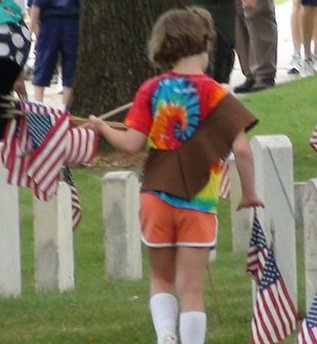
Happy Memorial Day!!!!!!


Many thanks goes out to this family….who I just happen to know…. and many others who took the time this weekend to head out to cemeteries like Marietta National to decorate the graves of our military men and women…….the original purpose behind the holiday when you go back far enough.


I have a few pictures from other Decoration Days over at History Is Elementary (follow this link)  along with a mention that today’s posting is my 800th at that site.

800!!! I’m glad it could happen on such a worthy day as this.

Have a great holiday!!!


Tuesday, May 17, 2011

Consulates and Trade Offices.....Oh my!

Earlier this week I posted a history column at Douglasville Patch regarding the Douglasville/Douglas County Cultural Arts Center as well as the history of the home the organization inhabits.

Currently the CAC is exhibiting Japanese block prints spanning the 1840s to 1910. The prints are on loan from the Japanese Consulate in Atlanta.

Sometimes it’s hard to remember Atlanta is home to over 50 different consulates, trade offices and chambers of commerce representing foreign nations, but we graciously welcome our foreign friends from Cyprus, Monaco, Nicaragua, Japan and many, many others you can see here.

It’s only natural Atlanta would have an abundance of international ties since we are home to one of the nation’s busiest airports, two deep water ports, and Georgia has access to over 80 percent of the U.S. industrial market with a two-day trip by truck. There are direct flights every day to Europe, South America, and Asia making Atlanta assessable to the more than 1,000 international businesses located in our city. In recent years Atlanta has become a major banking center and 13 Fortune 500 companies designate Atlanta as their headquarters.

We have most certainly come a long way since 1837 when Atlanta was known as Terminus and was the end of the line for the Western & Atlantic railroad line.

Saturday, March 26, 2011

Beaux-Arts: Lovely!

Having been born and raised in and near Atlanta I’ve driven by the Candler Building, the building in the middle of this picture, many times, but never taken the time to really look at it.

One Sunday morning last October I found myself pushing my way through the glass revolving door at the Ritz Carlton on Peachtree blinking the sleep from my eyes and grasping my camera firmly.

I was determined to snap a few pictures along Peachtree Street. Within a two or three block distance I had taken hundreds……As you see; I have a weakness for buildings and architectural elements.

Atlanta’s Candler Building was named for Asa G. Candler, Atlanta’s 44th mayor, the man who took the Coca Cola formula and launched the company into the marketing icon it is today, and the man who is the brainchild and developer of the building in my pictures.


The building is located at 127 Peachtree Street and was built in 1906. At seventeen floors it was at the time Atlanta’s tallest and most innovative office building.

Built in the Beaux-Arts architectural style the Candler Building is also one of Atlanta’s loveliest structures. Beaux-Arts depend heavily on sculptural decoration along with flat roofs, and arched doors with pediments. The sculpture elements generally coordinate to follow along some sort of theme.

The Candler Building website states: The Candler Building's elaborately-carved facade and stunning lobby pay tribute to the world's leaders in arts and sciences. The marble busts and ornamental friezes were handcrafted by a select group of international artists. This stonework was carved from north Georgia Amicalola marble, personally selected by Mr. Candler and architect George Murphy.


This website states: Typical of the era, its exterior was visually and structural divided into three parts--a two-story base, a 12-story shaft and a three-story capital with large overhanging cornice. The interior of the Candler Building featured special floors designed for use by doctors, dentists, and surgeons; a banking hall; six passenger elevators which were "at all times under the charge of a thoroughly competent engineer"; a barbershop; and what were said to be the "finest baths in America," located in the first basement of the building. Duplicate air-cooling and electric systems were installed to reduce the chance of a total systems failure, and a building-wide "vacuum air-cleaning device" was installed. The triangular building had entrances on all three sides; the largest and most elaborate of these was on the Houston Street side and provided access to the Central Bank and Trust Corporation, which Candler organized in 1906 to occupy the lobby floor of his new skyscraper.

The interior of the building is full of marble, brass, Tiffany glass, and mahogany. In fact, the elevator cabs boast some exceptional mahogany carvings and can be seen in this video:


The Candler Building website contains some great past-present pictures of the building and surrounding neighborhood here, and this website has more images as well.

Another building in the Beaux-Arts style found in Atlanta is the Old Federal Post Office built by James Knox Taylor. Today this building is used as the 11th Circuit Court of Appeals. You can find out more about the building here.

Wednesday, February 2, 2011

Every Little Thing is Just Peachy!

Have you found That's Just Peachy yet?

It is my first stop when I want Georgia news. That's Just Peachy is set up like the Drudge Report, but specifically for Georgia. It’s the one-stop shop for news and views from around the state and covers headlines from across Georgia every day.

That's Just Peachy is an attempt to help connect Georgians to issues and stories that effect their everyday lives. Content for the website is pulled from a variety of newspapers, television and radio stations, and the ever-increasing-in-importance blogging community.

Oftentimes, it is easy for the urban, suburban, and rural areas of states to forget or not realize how connected we all are and That's Just Peachy tries to synthesize these important issues into a single site.

 Head on over and take a look and tell them ElementaryHistoryTeacher sent you.

That's Just Peachy has been added to the Georgia blogroll which has recently been updated and fine tuned a little.

You can find That's Just Peachy on Facebook…….and don’t forget to “like” Georgia on My Mind on Facebook as well.
Related Posts Plugin for WordPress, Blogger...