If you check basic records spanning across the 237 year history of the United States you discover time after time counties, cities, buildings, bodies of water, people, and even a state have been named for our first president, George Washington including our own Washington County located in the eastern central part of the state.
Taking a closer look, however, you discover that Washington County, Georgia was named for General George Washington in 1784 - five years before he became president.
Georgia's Washington County is the only county in the United States that solely honors Washington's service as Commander-in-Chief of the Continental Army during the American Revolution.
It does make sense when it is realized that the county, per the Washington County Historical Society, was formed for the express purpose of issuing bounty land grants to Revolutionary War soldiers such as Jared Irwin who not only reached the rank of colonel during the American Revolution but was also elected governor of Georgia in 1796 and 1806.
Bounty land grants were given to soldiers for services rendered - basically free land for military service.
In 1784, Washington County covered a much larger area than it does today. It was created from Creek Indian Land cessions of November 1, 1783 and was the 10th county formed in the state. The counties of Greene, Hancock, Johnson, Treutlen, Montgomery, Toombs, Tattnall, Evans and portions of Long, Liberty, Candler, Emmanuel, Jefferson, Baldwin, Taliaferro, Oconee and Oglethorpe counties.
The first county seat was at Warthen where today you can find the restored jail seen in an older picture below. It is considered to be the oldest log jail in the state today.
Per Georgia's DNR website for Georgia's State Parks, the jail's most famous occupant was Aaron Burr, third Vice-President of the United States. In 1807, he had been arrested in Mississippi for treason against the United States and was being carried to Richmond, Virginia to stand trial. They reached Warthen at dusk, so Burr spent the night in the little jail while the officers in charge were entertained in the home of Richard Warthen, one of the original recipients of the bounty land grants mentioned above.
By 1796, the county seat had been moved to Sandersville. A courthouse was built, but it was lost in a fire that took most of the town in 1855. A new brick courthouse was constructed a year later.
It is said during the Civil War that Washington County sent more soldiers to serve the Confederate cause than any other. Fifteen different companies were organized there.
Towards the end of the Civil War the 1856 courthouse was burned by the Union. Perhaps it had something to do with the fact that the Confederates had fired upon advancing Union troops from the upper floors of the building.
Yet another courthouse was built in 1869 and still stands today. Additions to this courthouse seen below were added in 1899 and 1939. Renovations and rehabilitations were done in the early 1970s and in 1987.
Photo of the old jail via Virtual Vault of Georgia
Photo of the 1896 courthouse via Georgia Info
Monday, July 15, 2013
Monday, July 1, 2013
Banishment in the Twenty-First Century - Georgia Style
In 1974, the Georgia Supreme Court upheld a criminal sentence for a woman who was banished from seven different counties for a year.
Immediately two questions pop into my head.
Seven counties!?!
Banished!?!
While I do have a list of folks....a very short list...running through my mind that would make great candidates for banishment from my county, I have to wonder what do you have to do in order to be banished.
After some checking it seems that habitual bad check or drug charges are at the top of list, but seriously...
How can banishment happen in the 21st century?
For the answer we have to go back to the 19th century when Georgia' s Reconstruction-era constitution was written (1877).
It clearly states Georgia citizens can be whipped or banished "beyond the limits of the state" meaning we can't banish someone to the wilds of Alabama...though some deserve it.
Georgia prosecutors and judges interpret the language to mean as long as the banishment is within Georgia's 159 counties it's allowable.
DeKalb County seems to use banishment more than most counties often telling drug offenders they are banished from 158 of Georgia's 159 counties leaving tiny Echols County as the number one travel destination for folks who are banished.
Now before your vision becomes clouded with thousands of U-Haul trucks heading south for Echols County I need to advise those who are banished are rarely checked on due to manpower and funds. However, it does seem like it might be a good use for some of those forfeited assets that some DA's like to spend willy nilly.
Echols County, as far as I know isn't the hotbed of crime it could be due to all the banishments. It IS known for two small towns and one traffic light. The county seat, Statenville is so small it's not even incorporated. Echols is one of three counties in the state that has a county seat that isn't incorporated.
In the beginning Statenville was actually known as Troublesome. I don't know the reason, but it seems to me that if they changed the name back to Troublesome it WOULD be the perfect place to banish troublesome folks.
Thinking a little bit more about the provision in the Georgia Constitution that mentions banishment.....it also provides for whipping.
I have some names for that list, too.
Immediately two questions pop into my head.
Seven counties!?!
Banished!?!
While I do have a list of folks....a very short list...running through my mind that would make great candidates for banishment from my county, I have to wonder what do you have to do in order to be banished.
After some checking it seems that habitual bad check or drug charges are at the top of list, but seriously...
How can banishment happen in the 21st century?
For the answer we have to go back to the 19th century when Georgia' s Reconstruction-era constitution was written (1877).
It clearly states Georgia citizens can be whipped or banished "beyond the limits of the state" meaning we can't banish someone to the wilds of Alabama...though some deserve it.
Georgia prosecutors and judges interpret the language to mean as long as the banishment is within Georgia's 159 counties it's allowable.
DeKalb County seems to use banishment more than most counties often telling drug offenders they are banished from 158 of Georgia's 159 counties leaving tiny Echols County as the number one travel destination for folks who are banished.
Now before your vision becomes clouded with thousands of U-Haul trucks heading south for Echols County I need to advise those who are banished are rarely checked on due to manpower and funds. However, it does seem like it might be a good use for some of those forfeited assets that some DA's like to spend willy nilly.
Echols County, as far as I know isn't the hotbed of crime it could be due to all the banishments. It IS known for two small towns and one traffic light. The county seat, Statenville is so small it's not even incorporated. Echols is one of three counties in the state that has a county seat that isn't incorporated.
In the beginning Statenville was actually known as Troublesome. I don't know the reason, but it seems to me that if they changed the name back to Troublesome it WOULD be the perfect place to banish troublesome folks.
Thinking a little bit more about the provision in the Georgia Constitution that mentions banishment.....it also provides for whipping.
I have some names for that list, too.
Labels:
Banishment,
Constitution,
Crime,
Echols County,
GOMM,
Seized Assets
Wednesday, June 26, 2013
Wordless: Atlanta Airport
Monday, June 24, 2013
Changing Pictures
In 1900, W.E.B. Du Bois - then a professor of sociology at Atlanta University - now known as Clark Atlanta University - compiled a series of 363 photographs in two albums titled Types of American Negroes and Negro Life in Georgia, USA which he put on display at the Paris Exhibition.
The exhibit also contained items including charts, maps, and graphs recording the growth of population, economic power and literacy among African Americans in Georgia - the Black middle class that existed some thirty-five years after slavery was outlawed via the 13th Amendment.
Today the Library of Congress site that houses the collection advises:
[Du Bois was] committed to combating racism with empirical evidence of the economic, social and cultural conditions of African Americans. He believed that a clear revelation of the facts of African American life and culture would challenge the claims of biological race scientists influential at the time, which proposed that African American men and women challenged the scientific "evidence" and popular racist caricatures of the day that ridiculed and sought to diminish African American social and economic success. Further, the wide range of hair styles and skin tones represented in the photographs demonstrated that the so-called "Negro type" was in fact a diverse group of distinct individuals. The one public statement Du Bois made concerning these photographs was that visitors to the American Negro exhibit would find "several volumes of photographs of typical Negro faces, which hardly square with conventional American ideas."
The sad thing is over one hundred years later very few students of history in our schools see these images. Instead they are bombarded with the same images of sharecroppers picking cotton in fields or sitting in the doorways of former slave cabins. While these people and their dismal situations did exist it wasn't the only "picture" of life for Blacks in the American South at the turn-of-the-century.
I'll be posting an album including several of the images at my Facebook page, but here are a few of the Georgia images.
This first image is David Tobias Howard who had his own carriage and driver. He's seated in the back with his wife and mother. Howard was a funeral director, and a high school in Atlanta's Old Fourth Ward is named for him.
The picture below is the home of Bishop Gaines of the AME Church in Atlanta.
The man behind the desk in the picture below is IRS Collector Henry A. Rucker....and an African American.
....and here are a couple of more:
The exhibit also contained items including charts, maps, and graphs recording the growth of population, economic power and literacy among African Americans in Georgia - the Black middle class that existed some thirty-five years after slavery was outlawed via the 13th Amendment.
Today the Library of Congress site that houses the collection advises:
[Du Bois was] committed to combating racism with empirical evidence of the economic, social and cultural conditions of African Americans. He believed that a clear revelation of the facts of African American life and culture would challenge the claims of biological race scientists influential at the time, which proposed that African American men and women challenged the scientific "evidence" and popular racist caricatures of the day that ridiculed and sought to diminish African American social and economic success. Further, the wide range of hair styles and skin tones represented in the photographs demonstrated that the so-called "Negro type" was in fact a diverse group of distinct individuals. The one public statement Du Bois made concerning these photographs was that visitors to the American Negro exhibit would find "several volumes of photographs of typical Negro faces, which hardly square with conventional American ideas."
The sad thing is over one hundred years later very few students of history in our schools see these images. Instead they are bombarded with the same images of sharecroppers picking cotton in fields or sitting in the doorways of former slave cabins. While these people and their dismal situations did exist it wasn't the only "picture" of life for Blacks in the American South at the turn-of-the-century.
I'll be posting an album including several of the images at my Facebook page, but here are a few of the Georgia images.
This first image is David Tobias Howard who had his own carriage and driver. He's seated in the back with his wife and mother. Howard was a funeral director, and a high school in Atlanta's Old Fourth Ward is named for him.
The picture below is the home of Bishop Gaines of the AME Church in Atlanta.
The man behind the desk in the picture below is IRS Collector Henry A. Rucker....and an African American.
....and here are a couple of more:
Monday, June 17, 2013
The Tuttle
Think about this for a minute...
What would happen if a rock formation in the shape of an eagle was discovered on a construction site?
Construction would stop, all sorts of experts would be called, groups would protest, the rock formation would receive its own Facebook page and most certainly mention of it would be found in the newspaper, right?
Apparently, finding a rock formation resembling an eagle during construction of a Federal courthouse and post office in 1907 wasn't a big enough deal to make the papers because I can't find one mention of it...anywhere.
Insert a heavy sigh here.
Atlanta has "The TED" referencing Turner Stadium, but we also have "The Tuttle".
Yes, "The Tuttle"...found at 56 Forsyth Street.
What would happen if a rock formation in the shape of an eagle was discovered on a construction site?
Construction would stop, all sorts of experts would be called, groups would protest, the rock formation would receive its own Facebook page and most certainly mention of it would be found in the newspaper, right?
Apparently, finding a rock formation resembling an eagle during construction of a Federal courthouse and post office in 1907 wasn't a big enough deal to make the papers because I can't find one mention of it...anywhere.
Insert a heavy sigh here.
Atlanta has "The TED" referencing Turner Stadium, but we also have "The Tuttle".
Yes, "The Tuttle"...found at 56 Forsyth Street.
I'm referring to the building above that houses the Eleventh Circuit Court of Appeals renamed in 1981 to honor Elbert Parr Tuttle, an Atlanta judge known for the large amount of pro bono civil rights work he handled during his legal career. Tuttle was awarded the Presidential Medal of Freedom in 1981 for his Civil Rights work.
The building itself has been the location of several important cases through recent years including the Elian Gonzales case and at least two of the decisions regarding Bush v. Gore were decided within the walls of the Tuttle building.
Also known as the U.S. Post Office and Courthouse from years past, the five-story building is huge. It occupies the block bordered by Forsyth, Fairlie, Poplar, and Walton Streets.
In 1907, Atlanta had grown to such proportions a new federal courthouse and post office was needed. Congress appropriated the money and on July 23, 1907 folks in Atlanta viewed this drawing of their million dollar plus courthouse on the front page of The Atlanta Constitution.
Architecturally, the building follows the Second Renaissance Revival style. Some windows contain carved serpent-and-staff designs associated with Mercury, the Roman messenger god - an early symbol used by the postal service.
A mural decorates the lobby portraying an allegorical Justice flanked by Industry and Agriculture.
The carved oak panels throughout the building are decorated with garlands, scrolled brackets and molding.
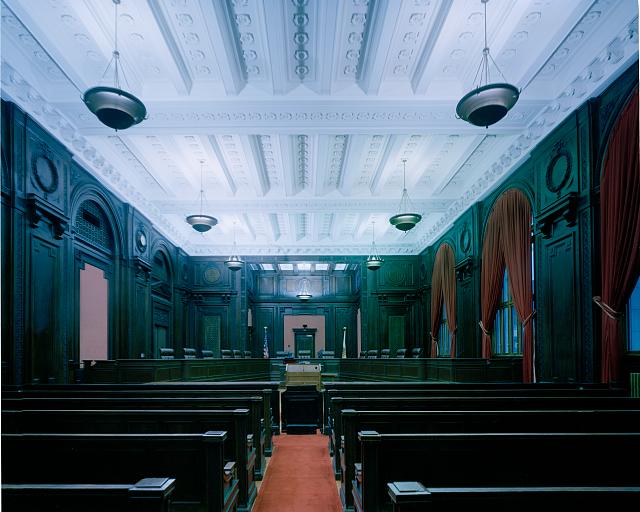
....and of course the courtrooms are magnificent with detail. Unfortunately,I don't think someone will be writing about many of the courtrooms of today one hundred years from now. They just don't capture the attention as buildings such as "The Tuttle".
James Knox Taylor, the supervising architect of the U.S. Treasury designed the building with ground being broken in 1906. As I read about the building the most amazing thing I found was a natural rock formation resembling an American Bald Eagle was discovered as the building's foundation was dug. Apparently, folks involved decided since it was a symbol of our country, it was a sign that the proper site had been chosen for a Federal building.
I've scoured the papers during the years of construction - 1906 to 1910 - and can't find a mention of the discovery.
Was this just some natural fluke in the topography of the site?
Was this evidence of Native Americans in the area?
Should it have been preserved?
Seriously....Why can't I find any further mention of the formation?
Sometimes, I can't find the answers I'm searching for, and it's very frustrating.
Pictures courtesy of the Library of Congress.
Architecturally, the building follows the Second Renaissance Revival style. Some windows contain carved serpent-and-staff designs associated with Mercury, the Roman messenger god - an early symbol used by the postal service.
A mural decorates the lobby portraying an allegorical Justice flanked by Industry and Agriculture.
The carved oak panels throughout the building are decorated with garlands, scrolled brackets and molding.
....and of course the courtrooms are magnificent with detail. Unfortunately,I don't think someone will be writing about many of the courtrooms of today one hundred years from now. They just don't capture the attention as buildings such as "The Tuttle".
James Knox Taylor, the supervising architect of the U.S. Treasury designed the building with ground being broken in 1906. As I read about the building the most amazing thing I found was a natural rock formation resembling an American Bald Eagle was discovered as the building's foundation was dug. Apparently, folks involved decided since it was a symbol of our country, it was a sign that the proper site had been chosen for a Federal building.
I've scoured the papers during the years of construction - 1906 to 1910 - and can't find a mention of the discovery.
Was this just some natural fluke in the topography of the site?
Was this evidence of Native Americans in the area?
Should it have been preserved?
Seriously....Why can't I find any further mention of the formation?
Sometimes, I can't find the answers I'm searching for, and it's very frustrating.
Pictures courtesy of the Library of Congress.
Monday, June 10, 2013
Stereoscopes: A View Back in Time
I regularly visit our local history museum in Douglasville for obvious reasons since I research and write about local history for our local news outlets and my Douglas County history blog as well.
The volunteers had moved a few things around. There were even some new exhibits including this:
Do you know what it is?
Well, think of a Viewfinder if you grew up in the 1960s or 70s like I did, and you will be on the right track.
Yes! You viewed pictures through the contraption, but not just any picture.
You viewed a picture card that looked like this:
Wisegeek tells us that a stereoscope is a viewing device which allows users to create a three-dimensional image from a set of two-dimensional photographs or drawings,
Wisegeek further advises the viewer would peer through a rudimentary binocular system, which forced each eye to see only one of the two images. By either crossing or diverging one's eyes, a third image would eventually appear in the middle, and this image would provide the illusion of depth for as long as the viewer maintained proper concentration and focus.
The stereoscope was invented by Sir Charles Wheatstone in 1838. He was a British physicist and was one of the inventors of the telegraph. Of course, in the earliest days the images were drawn by hand, but after photography entered the mix stereoscopes became very popular.
In 1851, Queen Victoria was able to view images through the stereoscope at the Crystal Palace Exhibition, and she was most certainly amused. Around 1860, Oliver Wendell Holmes, Sr.....yes, THE statesman Oliver Wendell Holmes took the British version and streamlined the design making it more affordable.
He actually wrote an article about the stereoscope for The Atlantic in 1859.
Take a look again at the stereograph I posted above. Notice the colored border around the pictures? It isn't just there for looks. The border actually adds to the three-dimensional quality of the image.
The device entered mainstream America, and its popularity took off like a rocket. Soon it seemed that everyone had one.
Stereoscopes were educational. Folks in the South could see how folks in the West lived. You could see parts of the United States as well as the world that most people would never be able to reach. Rail transportation and industry became a popular theme as well as rural and city scenes.
There were even nude stereographs, too.
Over 300 million stereographs were issued between 1854 and 1920. Families could purchase some of the images six for a dollar. Cheaper stereographs went for three cents each or eighty-five cents for 100. They were found in drugstores, mail order catalogs, given away as premiums by tea and cereal companies and college students even went door to door to sell them. Carl Sandburg actually made a few dollars selling stereograms.
It wasn't long before the equipment made its way into America classrooms and photo sets were being marketed for schools. I'm fairly certain the nude ones were left off the school inventory lists.
Today, the stereograms or photographs are more collectable than the viewer. I've even thought of collecting some of my own, but want to decide on a topic or theme first.
In the meantime, I've found several stereograms online that depict life in Savannah, Atlanta, Augusta, and many other Georgia locations. I'll be posting them over the next several days on Facebook.
Are you a Facebook friend with "Georgia on my Mind"? It's easy to do. Find the "like" box over on the left sidebar and click the "like" button.
See you on Facebook!
The volunteers had moved a few things around. There were even some new exhibits including this:
Do you know what it is?
Well, think of a Viewfinder if you grew up in the 1960s or 70s like I did, and you will be on the right track.
Yes! You viewed pictures through the contraption, but not just any picture.
You viewed a picture card that looked like this:
Wisegeek tells us that a stereoscope is a viewing device which allows users to create a three-dimensional image from a set of two-dimensional photographs or drawings,
Wisegeek further advises the viewer would peer through a rudimentary binocular system, which forced each eye to see only one of the two images. By either crossing or diverging one's eyes, a third image would eventually appear in the middle, and this image would provide the illusion of depth for as long as the viewer maintained proper concentration and focus.
The stereoscope was invented by Sir Charles Wheatstone in 1838. He was a British physicist and was one of the inventors of the telegraph. Of course, in the earliest days the images were drawn by hand, but after photography entered the mix stereoscopes became very popular.
In 1851, Queen Victoria was able to view images through the stereoscope at the Crystal Palace Exhibition, and she was most certainly amused. Around 1860, Oliver Wendell Holmes, Sr.....yes, THE statesman Oliver Wendell Holmes took the British version and streamlined the design making it more affordable.
He actually wrote an article about the stereoscope for The Atlantic in 1859.
Take a look again at the stereograph I posted above. Notice the colored border around the pictures? It isn't just there for looks. The border actually adds to the three-dimensional quality of the image.
The device entered mainstream America, and its popularity took off like a rocket. Soon it seemed that everyone had one.
Stereoscopes were educational. Folks in the South could see how folks in the West lived. You could see parts of the United States as well as the world that most people would never be able to reach. Rail transportation and industry became a popular theme as well as rural and city scenes.
There were even nude stereographs, too.
Over 300 million stereographs were issued between 1854 and 1920. Families could purchase some of the images six for a dollar. Cheaper stereographs went for three cents each or eighty-five cents for 100. They were found in drugstores, mail order catalogs, given away as premiums by tea and cereal companies and college students even went door to door to sell them. Carl Sandburg actually made a few dollars selling stereograms.
It wasn't long before the equipment made its way into America classrooms and photo sets were being marketed for schools. I'm fairly certain the nude ones were left off the school inventory lists.
Today, the stereograms or photographs are more collectable than the viewer. I've even thought of collecting some of my own, but want to decide on a topic or theme first.
In the meantime, I've found several stereograms online that depict life in Savannah, Atlanta, Augusta, and many other Georgia locations. I'll be posting them over the next several days on Facebook.
Are you a Facebook friend with "Georgia on my Mind"? It's easy to do. Find the "like" box over on the left sidebar and click the "like" button.
See you on Facebook!
Tuesday, May 7, 2013
All Wright - No Wrongs
One of my favorite movies from the late 1950s is A Summer Place mainly because I like Sandra Dee, and I'm in awe of the scenery. The story is set along the coast of Maine, but was filmed on the Pacific Coast at Carmel-by-the-Sea.
You know, that place where "Dirty Harry" happened to be the mayor for a bit.
While all of the scenery in the movie is fascinating, one location has always held my attention - the fictional residence for one of the couples. It is referenced in the movie that the home was designed by Frank Lloyd Wright, and indeed it was!
The home is known as Walker House (photo courtesy of Brooks Walker). It's located on Scenic Road in Carmel-by-the-Sea. It was designed by Frank Lloyd Wright in 1948.
I saw some friends were discussing the movie and the house on Facebook, so I naturally joined in by sharing this particular link to a post written by Mrs. Walker's grandson, Brooks Walker who is also an architect.
The discussion turned to how some of us would love to go on a tour across the United States to see first-hand some of the homes and buildings designed by Frank Lloyd Wright.
I think it would be a most interesting trip.
However, it would take time and money, but you have to start somewhere, right?
So, I checked to see if Georgia had any structures attributed to Frank Lloyd Wright.
Sadly, no.
However, it is possible for my first notch in my "Frank Lloyd Wright" belt I won't have to go too far.
Right here in Georgia we do have a home attributed to Frank Lloyd Wright's style.
I found an article at Curbed-Atlanta regarding architect Robert M. Green - one of Frank Lloyd Wright's last apprentices and a Georgia native originally from Savannah. It's a great article with a few pictures of the home.
It's called the Arrowhead House (picture courtesy of Curbed-Atlanta).
The Arrowhead House is located in North Druid Hills. Robert M. Green began designing homes and commercial structures in the Atlanta area in 1960. Arrowhead House was built in 1964 for developer Robert Witcher and was named for the unique shape of the primary structure and the arrow-like appearance the plan had on paper.
The house was on the market as recently as February, 2013...I'm not sure if it's been snapped up yet.
A great Flickr set of Arrowhead House can be found here.
I'm off to find my belt, so I can start making those notches!
You know, that place where "Dirty Harry" happened to be the mayor for a bit.
While all of the scenery in the movie is fascinating, one location has always held my attention - the fictional residence for one of the couples. It is referenced in the movie that the home was designed by Frank Lloyd Wright, and indeed it was!
The home is known as Walker House (photo courtesy of Brooks Walker). It's located on Scenic Road in Carmel-by-the-Sea. It was designed by Frank Lloyd Wright in 1948.
I saw some friends were discussing the movie and the house on Facebook, so I naturally joined in by sharing this particular link to a post written by Mrs. Walker's grandson, Brooks Walker who is also an architect.
The discussion turned to how some of us would love to go on a tour across the United States to see first-hand some of the homes and buildings designed by Frank Lloyd Wright.
I think it would be a most interesting trip.
However, it would take time and money, but you have to start somewhere, right?
So, I checked to see if Georgia had any structures attributed to Frank Lloyd Wright.
Sadly, no.
However, it is possible for my first notch in my "Frank Lloyd Wright" belt I won't have to go too far.
Right here in Georgia we do have a home attributed to Frank Lloyd Wright's style.
I found an article at Curbed-Atlanta regarding architect Robert M. Green - one of Frank Lloyd Wright's last apprentices and a Georgia native originally from Savannah. It's a great article with a few pictures of the home.
It's called the Arrowhead House (picture courtesy of Curbed-Atlanta).
Subscribe to:
Posts (Atom)
.jpg)