Google+ Georgia On My Mind

Tuesday, August 20, 2013

A Clubhouse for Bobby

Way back in 1896 a group of men formed a club to honor their favorite poet, and by 1907 they wanted to build a clubhouse.

What else is new, right? It begins in childhood – groups of boys want a hut or a fort excluding the girls so they can go about their “guy” business without any bossing from the females.  Just because the boys grow up doesn’t mean they are over the fact that they want “boy” time.
The Burns Club of Atlanta was no different. It was men’s only club, and they needed a permanent place to meet all their own.

Club member Joseph Jacobs of Jacob’s drugstore fame told the members if they found a suitable plot of land he would make the purchase, and over time the club could pay him back.  Mr. Jacobs had a little income due to a successful drugstore, and it was Jacobs who had made the suggestion to add a little carbonation to some newfangled drink called Coca-Cola.

The club had been meeting around Atlanta in various hotels. They wanted to find a place that was outside the city, but still close enough in that they could catch the last train after dinner to head home.
They finally found ten acres off Confederate Avenue in the Ormewood Park area, a suburb of Atlanta that was originally developed in 1892.  It’s a little hard to wrap my head around the idea that Ormewood Park was not in the city of Atlanta, but during the early 20th century it wasn’t.

The club members set about building a replica of a cottage in Alloway, Ayrshire, Scotland which happened to be the home of Robert Burns, the 19th century poet the club members honored.
Come on, you remember Robert Burns from your high school and college literature courses, right?  Burns is famous for poetic lines such as, “O my Luve’s like a red, red rose, That’s newly sprung in June…” and every New Year’s Eve we all remember Burns when we sing the lyrics to Auld Lang Syne

Club member Thomas H. Morgan, an architect set to work on building a clubhouse that was an exact replica of the Burns’ home in Scotland.
This website states…..

The interior of the house is also a close replica of the Scottish cottage, and was divided into the traditional four areas: but, ben, barn, and byre. At the far end is the but, which would have been the kitchen, dining room, and parents' bedroom. Next to the but is the ben, which would have served as the living room and childrens' bedroom. These two rooms are decorated with memorabilia from the life of Robert Burns. The assembly room, which replaces the barn and byre, is used for club meetings. The three fireplaces in the cottage are constructed of random stones with mortar joints raised and rounded. The fireplace in the center of the cottage has an inset stone plaque in memory of the poet. The only remaining outbuilding is a one-story stone caretaker's house, originally a log cabin. It was redesigned in 1969 to bear a closer resemblance to the cottage. The grounds once covered 10 acres and included a dance pavilion, barbeque pit and shed, a tennis court and putting green for club use and for rental to other groups. Changes to Burns Cottage include the rear addition of small, functional kitchen, porch and restrooms. The assembly room's original stone-flagged floor was replaced with a concrete one, a fireplace was added at the far end, and some of the small windows were closed.
Early on the cabin had a thatched roof, but eventually the Fire Marshall determined the roof should be replaced.

Since the clubhouse was finished in 1911 the Burns Club of Atlanta has used the building for their meetings. Once a year on January 25th they hold a special super to celebrate Robert Burns’ birth.
The Burns Club of Atlanta is said to be the city’s oldest continuing social, literacy and cultural organization. The club is private. There are no tours. The only way I could attend a dinner or meeting is if I’m invited by a member.

So, are there any members out there?
 The photograph with this post is used via the Tracy O'Neal Photography Collection at Georgia State University Library. It dates to 1944

Sunday, August 11, 2013

Facing North


If we are really honest with ourselves we all have a few enemies.

Some are real, and some are imagined.

Some enemies are bad habits while others are thoughts and feelings, too.

Sometimes we have a collective enemy like William Ezra Curtis of Carroll County, Georgia.

His enemy happened to be the United States of America because Curtis was a solder in the Confederate Army.

The Curtis family goes way back to the earliest thoughts of Carrollton. William Ezra Curtis' father, Henry, provided the land where Carrollton's town square is located today. Henry Curtis was also the trustee of Carrollton's first school, the Carrollton Academy, and served with the Interior Court as the reviewer of roads. Today the Curtis home is the location of the Carroll County Historical Society.

At the outbreak of the Civil War, William Ezra Curtis joined the Carroll Guards, one of the first volunteer units to be organized in Carroll County. Curtis was placed in Company F of the 19th Georgia and was sent to Virginia early in the war.

By March, 1862 Curtis was appointed Lt. Colonel, and he was given the 41st Georgia Regiment to command. The group was sent to the Army of the Mississippi. Curtis was captured at Vicksburg and paroled there July, 1863.

Rather than just giving up and returning home Curtis decided to face his enemy once more and head back into the thick of battle. By this time the 41st was in Georgia and William Ezra Curtis faced his enemy on home territory and watched folks on the home front scatter before Sherman's onslaught towards Atlanta.

Curtis was wounded somewhere at Mill Creek Gap on February 25, 1864. He was taken to his in-laws home near Newnan, Georgia where he died March 24, 1864.

William Ezra Curtis had one last request. He wanted to be buried facing the enemy, so that is why his is the only grave in the Carrollton City Cemetery that faces north to south rather than east to west.

The human journey through life is an interesting one full of happy moments, sad moments, moments of great success and devastating failure, but one of the most important aspects of our character, I think, has to do with facing our enemies.

Have you identified your enemies?

Devise a plan, and face them!

Thursday, August 1, 2013

The Chattahoochee Isn't Just a River

The subject of the Confederate Navy is not generally touched on during history courses in our high schools, middle schools, or even the history curriculum I used to teach fourth and fifth graders a few years ago. The only scant mention involves the match-up between the CSS Virginia (Merrimac) and Monitor, but even then it's given drive-by treatment since the Confederate Navy isn't tested, and quite frankly there is other content to introduce.

I would hope Georgia history teachers at the 8th grade level discuss Georgia's part in building the Confederate Navy, but then again, I'm not so sure it's done for many different reasons.

The Confederate States of America established their Navy on February 21, 1861. From the outset the goal was not to match the size of the United States Navy. Instead, the Confederates planned on using innovative technological advances to gain tactical superiority utilizing new ideas such as submarines, torpedo boats, mines, and ironclads.

The Confederate goals were simple. They wanted to hinder the Union efforts by attacking U.S. merchant ships world-wide, and break the Union blockade along southern coasts that had put a strangle-hold on the southern economy.

While I could write volumes regarding the Confederate Navy, I want to touch on a little known part Georgia had to play regarding naval development.

First, we look to Columbus, Georgia along the Chattahoochee River. The Iron Works in Columbus had been in operation for a long time making farm equipment, stoves, and decorative iron pieces, but by June, 1862, the Confederate Navy leased the Columbus Iron Works, and led by John H. Warner, a former U.S. Navy engineer, the Iron Works grew into the largest manufacturer of naval machinery within the Confederacy.

One of the gunboats commissioned was the CSS Chattahoochee.

The CSS Chattahoochee?

Yes, it's not just the name of a river that winds it's way through points north of Atlanta and far south. It was also the name of a Confederate gunboat built on the river of the same name.

The story surrounding the Chattahoochee took place in Saffold, Georgia. Today, Saffold, located in Early County is about as far south as you can travel in Georgia without being in Florida. It's as remote today as it was back in 1862 when the ship was built even though there are some houses on the property today. Saffold is 175 miles south of Columbus and 140 miles upriver from Apalachicola.

In the Fall of 1861 Confederate Navy officers and the chief engineer for the Columbus Naval Works selected Saffold as the spot to build the Chattahoochee because it was so remote, plus the area had an abundance of timber. In fact, several of the sources I have reviewed state as many as five thousand board feet of lumber a day could be had from the local sawmill. 

Another reason for choosing the Saffold location had to do with David S. Johnston, a planter living in Saffold. I like to think of him as Georgia's answer to Noah. Johnston had a strong desire to help the Confederacy, but other than the location of his plantation, the fact he had access to the lumber, and had a ready-made labor force of 90 slaves, Johnston had absolutely NO experience building a boat of any kind.

Johnston's contract with the Confederate Navy called for the ship to be delivered in 120 days at a cost of $47,500.

This website has a few pictures of the Saffold site and describes the Chattahoochee as a three-masted steam vessel armed with four smoothbore 32-pounders in broadside, a 9-inch Dahlgren on a front pivot and a 32-pounder rifle on the rear pivot.

Some sources have described the Chattahoochee as a riverboat and ocean sailing craft all rolled into one equipped with steam engines and sails. The mission plan for the CSS Chattahoochee was simple - steam downriver, break the blockade and open the port of Apalachicola in order to return supply ships and trade to the region.


But there were problems, of course.

First, the deadline for Johnston to deliver the ship came and went which is not really a surprising detail since Johnston and his slaves had no ship building experience.

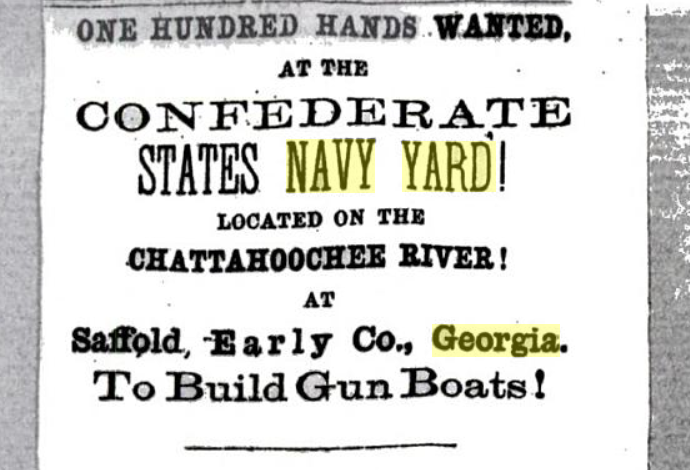
Realizing skilled workers were needed for certain aspects of the ship's design Johnston placed an ad in the Columbus Daily Sun touting "steady employment and good wages for ship carpenters, joiners, caulkers", etc.


To further entice folks a line at the bottom of the ad said, "All hands employed at the Confederate States Naval Yard are exempt from military duty and anyone in the army can be furloughed to work there."

Navy officers also began suspecting Johnston was using the yard at Saffold for personal business rather than completing the contract, so a strict timetable was put into place.

Finally, ten months past the original deadline the CSS Chattahoochee was delivered on December 8, 1862.

It's clear that originally the Confederate Navy had great plans for the Chattahoochee based on the fact that Lt. Catesby ap Roger Jones was chosen to command the gunboat. Jones had become a famous southern hero when he commanded the CSS Virginia (Merrimac) against the USS Monitor. In case you are wondering.....the "ap" in Jones' name is Welsh meaning "son of".

The Chattahoochee was finally launched in February, 1863. Unfortunately, it ran aground and seriously damaged its hull its first day out.

By the time it was ready to go again the Confederates had sunk obstructions in the Apalachicola River to keep Union ships from venturing up the river. Those same obstructions dashed the hopes of the Chattahoochee's crew from engaging the enemy. During most of 1863, the ship remained  above the obstructions basically serving as a glorified gun battery occasionally holding drills, but that's about it.

It was safe duty, but also boring duty.

Jones moved on to another post and Lt. J.J. Guthrie took command. In late May, 1863 the Chattahoochee steamed down the Apalachicola to aid the schooner Fashion that had taken on cotton and was planning to run the blockade. It had been captured by the Union below the obstructions, but many historians believe Lt. Guthrie intended on ramming the obstructions, but many historians believe Lt. Guthrie intended on ramming the obstructions to give the Fashion assistance.

This site advises further:

Tragically, neither the captain nor his crew knew that a severe early season hurricane was about to move in from the Gulf. The wind and rain increased through the night and by the morning of May 27, 1863 when Guthrie returned, the vessel was already feeling the brunt of the approaching storm. These conditions probably contributed greatly to what happened next. As the crew prepared to raise steam for the trip upriver, an argument broke out over how much water was in the boiler. Reportedly, a gauge was not working and before the ship's chief engineer could intervene, a massive steam explosion rocked the vessel.

It is widely believed this malfunctioning gauge caused the crew to unknowingly allow the boiler to grow red hot before filling it with water. When water poured in hitting the red hot metal casing, it instantly vaporized and burst through various sections of piping attached to the boiler. Sixteen members of the crew were killed within minutes, through being scalded by the steam. Another was mortally injured from a large lump of flying metal ripping upwards through the deck. Two more men were severely wounded and another four received minor injuries. Panicked into believing the ship's gunpowder store adjacent to the magazines might explode, the remaining crew opened plugs in the ship's hull and let her sink to the bottom of the muddy river. Descriptions of what conditions on the deck of the Chattahoochee were like vary; but most confirm a total loss of order by her officers, with men running about frantic with fear and in pain from their wounds. Many jumped overboard and at least three bodies were recovered downstream some days later. The dead and wounded were eventually taken ashore despite an increasing and raging storm.....The ship was quickly recovered and towed upriver to Columbus where she was again refitted.

Refitted again?

Yes, but again the ship didn't see any service. As the Union gained ground in April, 1864 and got closer to Columbus the crew of the Chattahoochee sank their ship in the Chattahoochee River to prevent its capture by the Union.

It would be one hundred years before the ship saw the sunlight again when it was located and raised. 


Part of the hull and the original steam engines are on display at the National Civil War Naval Museum in Columbus, Georgia.

Yes! Columbus, Georgia has a naval museum....

Instead of blowing through the town on my way to Florida next time, I think we need to spend the night and investigate Columbus a little.

Tuesday, July 23, 2013

Atlanta Pioneer: Er Lawshe

Some months ago my husband and I took a little field trip over to the Atlanta Zoo. While there we visited the Cyclorama, too. Walking through the exhibits I noticed a picture of this house.


The Lawshe House.

I came home, downloaded the pictures and meant to refresh my memory regarding the Lawshe family and their home, but forgot....until now.

The home, built in 1859, sat on the west side of Peachtree one lot north of Cain Street. It's a classic for the time period with porches on both levels.

Er Lawshe (yes, that's his real name) came South from Lewisburg, Pennsylvania with two of his brothers in 1848. Lawshe had apprenticed as a cabinetmaker in Philadelphia. When arrived in Atlanta he had $7.25 in his pocket.

The picture below shows Mr. Lawshe with his bride, Sarah.


Originally, Lawshe partnered with Riley Baker in a jewelry business selling watches and other items. Later he struck out on his own and was very successful to the point he was able to build the fine two-story home at 224 Peachtree Street which adjoined property owned by his in-laws.

During the Civil War Er Lawshe fought for Confederacy meaning that he was actually fighting against many of his family members. The Lawshe family left Atlanta in February, 1865 and headed to Augusta leaving their home basically abandoned as so many others. This made many of Atlanta's fine Peachtree Street mansions readily available for Union officers once they entered the city, and the Lawshe home was no different.

Brigadier General Felix Salm-Salm and his wife Agnes arrived in Atlanta on July 7, 1865 and chose the Lawshe home to live while he was in command of the Atlanta post. Salm-Salm was a  rather colorful fellow. He was from Westphalia, Prussia and was actually a prince of royal blood. He had served in the Prussian cavalry and once the Civil War broke out he joined the Union where he was commissioned in the 8th New York regiment. His wife was an American - the former Agnes Clerq of Baltimore. She was so in love with her husband she never wanted to be apart from him. Agnes would actually join him on the battlefield. She shocked Atlantans by riding through town astride her horse rather than sidesaddle as ladies of good breeding did at the time, but it is said she showed sympathy and compassion for the folks of Atlanta while she was here. They entertained at the Lawshe home by giving simple dinners and teas before leaving the city in October, 1865. 

When the Lawshe family returned following the end of the war Atlanta was of course in ruins, but their home was one of just a few still standing. Lawshe would not replace the boards that clearly showed shell damage.

Er Lawshe set about rebuilding his business at 47 Whitehall, but since there were no materials he resorted to using some of items Union soldiers had used to construct huts with while the city was occupied. In some cases the materials were just debris. Later when he was able he built a three-story brick building on the site of the store.

Er Lawshe also wrote various stories for The Atlanta Constitution later in his life. He was very well thought of in Atlanta and many claimed this was due to his integrity so much so he earned the nickname "Old Reliable".

After Lawshe passed away his home was sold for $18,000 to the Gate City Guards where they would eventually build their armory.

Monday, July 15, 2013

Surprising History in Washington County

If you check basic records spanning across the 237 year history of the United States you discover time after time counties, cities, buildings, bodies of water, people, and even a state have been named for our first president, George Washington including our own Washington County located in the eastern central part of the state.

Taking a closer look, however, you discover that Washington County, Georgia was named for General George Washington in 1784 - five years before he became president.

Georgia's Washington County is the only county in the United States that solely honors Washington's service as Commander-in-Chief of the Continental Army during the American Revolution.

It does make sense when it is realized that the county, per the Washington County Historical Society, was formed for the express purpose of issuing bounty land grants to Revolutionary War soldiers such as Jared Irwin who not only reached the rank of colonel  during the American Revolution but was also elected governor of Georgia in 1796 and 1806.

Bounty land grants were given to soldiers for services rendered - basically free land for military service.

In 1784, Washington County covered a much larger area than it does today. It was created from Creek Indian Land cessions of November 1, 1783 and was the 10th county formed in the state. The counties of Greene, Hancock, Johnson, Treutlen, Montgomery, Toombs, Tattnall, Evans and portions of Long, Liberty, Candler, Emmanuel, Jefferson, Baldwin, Taliaferro, Oconee and Oglethorpe counties.

The first county seat was at Warthen where today you can find the restored jail seen in an older picture below. It is considered to be the oldest log jail in the state today.


Per Georgia's DNR website for Georgia's State Parks, the jail's most famous occupant was Aaron Burr, third Vice-President of the United States. In 1807, he had been arrested in Mississippi for treason against the United States and was being carried to Richmond, Virginia to stand trial. They reached Warthen at dusk, so Burr spent the night in the little jail while the officers in charge were entertained in the home of Richard Warthen, one of the original recipients of the bounty land grants mentioned above.

By 1796, the county seat had been moved to Sandersville. A courthouse was built, but it was lost in a fire that took most of the town in 1855. A new brick courthouse was constructed a year later.

It is said during the Civil War that Washington County sent more soldiers to serve the Confederate cause than any other. Fifteen different companies were organized there.

Towards the end of the Civil War the 1856 courthouse was burned by the Union. Perhaps it had something to do with the fact that the Confederates had fired upon advancing  Union troops from the upper floors of the building.

Yet another courthouse was built in 1869 and still stands today. Additions to this courthouse seen below were added in 1899 and 1939. Renovations and rehabilitations were done in the early 1970s and in 1987.


Photo of the old jail via Virtual Vault of Georgia
Photo of the 1896 courthouse via Georgia Info

Monday, July 1, 2013

Banishment in the Twenty-First Century - Georgia Style

In 1974, the Georgia Supreme Court upheld a criminal sentence for a woman who was banished from seven different counties for a year.

Immediately two questions pop into my head.

Seven counties!?!

Banished!?!

While I do have a list of folks....a very short list...running through my mind that would make great candidates for banishment from my county, I have to wonder what do you have to do in order to be banished.

After some checking it seems that habitual bad check or drug charges are at the top of list, but seriously...

How can banishment happen in the 21st century?

For the answer we have to go back to the 19th century when Georgia' s Reconstruction-era constitution was written (1877).

It clearly states Georgia citizens can be whipped or banished "beyond the limits of the state" meaning we can't banish someone to the wilds of Alabama...though some deserve it.

Georgia prosecutors and judges interpret the language to mean as long as the banishment is within Georgia's 159 counties it's allowable.

DeKalb County seems to use banishment more than most counties often telling drug offenders they are banished from 158 of Georgia's 159 counties leaving tiny Echols County as the number one travel destination for folks who are banished.

Now before your vision becomes clouded with thousands of U-Haul trucks heading south for Echols County I need to advise those who are banished are rarely checked on due to manpower and funds. However, it does seem like it might be a good use for some of those forfeited assets that some DA's like to spend willy nilly.

Echols County, as far as I know isn't the hotbed of crime it could be due to all the banishments. It IS known for two small towns and one traffic light. The county seat, Statenville is so small it's not even incorporated. Echols is one of three counties in the state that has a county seat that isn't incorporated.

In the beginning Statenville was actually known as Troublesome. I don't know the reason, but it seems to me that if they changed the name back to Troublesome it WOULD be the perfect place to banish troublesome folks.

Thinking a little bit more about the provision in the Georgia Constitution that mentions banishment.....it also provides for whipping.

I have some names for that list, too.

Wednesday, June 26, 2013

Wordless: Atlanta Airport


It's been many weeks since I participated in Wordless Wednesday.  This picture of the Atlanta airport as I remember it when I was a little girl prompted me to participate.

You can like Georgia on my Mind's Facebook page here.

Find other bloggers participating in Wordless Wednesday here.
Related Posts Plugin for WordPress, Blogger...