Google+ Georgia On My Mind

Monday, October 7, 2013

Palmetto's Railroad Depot Museum

By the time I was aware of the Atlanta and West Point Railroad depot buildings they were all but abandoned since the railroad no longer used them by the mid-1960s.

Red Oak's depot was moved to another location. I'm sure the depot in College Park was used for something, but I can't remember. I do remember a law firm making their home in Fairburn's depot (it's still there), and the city of Palmetto used their depot for city offices including the police department.

The other day as I was heading through Palmetto I noticed they had opened a museum in their depot.

I decided to take a few minutes and stop. I'm glad I did. The docent and I had a lovely time sharing history.

Palmetto's depot was built somewhere between 1914 and 1917 with plenty of room for freight on one side of the building and passengers on the other. At the time the depot was built, the rails through Palmetto didn't set up as high as they do now. In fact, they dipped down to the point that sometimes the train would get stuck and an engine would be dispatched to come behind the train to "push" it along. The passengers would disembark and then have to come through a small tunnel underneath the depot and climb the steps to reach the passenger waiting room.

Once the depot was no longer needed for rail travel the city managed to rent it from CSX Railroad for $100 a year. The sweet deal came to fruition because a former mayor was a CSX employee.

When the city moved out the building sat, and like so many older beauties, it began to decay. Many thought it just needed to be torn down. After all...the roof had holes in it, and there was an asbestos issue.


Thankfully, in the year 2000 the railroad sold the depot to the city for $14,000. Once the deed was in the city's name, a group of historically minded citizens applied for a couple of grants. One in particular was a Georgia Transportation grant for $1.2 million dollars with an 80/20 split. The city would have to contribute 20 percent of the money used to restore the depot, but the majority of funds would be given. A second grant was obtained for $200,000.
Eighteen months later and just one year ago, a ribbon cutting celebration was given, and there was quite a bit to show off.
 
The restored depot houses a conference room at one end and space for special events on the other end. The special events section of the depot has the original depot flooring including the original freight scale embedded in the floor.
 
  
You can see the depot agent's office, the original ticket window and all the doors and windows are original to the property. There is also a train-side deck/patio.


Of course, for some folks the word "train" in the official name of the museum is confusing since the focus is Palmetto's history and NOT trains. There are no trains featured in the historical exhibits, but they DO cover Palmetto's history with new things being added all the time.

The museum is in the middle section of the depot with the brick walls lined with vintage furniture, objects, clothing and other memorabilia.


The museum also owns a vast collection of historic photographs.

A couple of penny-farthing bikes donated by former Palmetto mayor, Robert Steed are on display. A penny-farthing bike gets its name from the high wheel/small wheel that resembles a British penny next to a farthing.


Take some time and learn some local history. The Palmetto Train Depot Museum located at 549 Main Street (Highway 29/Roosevelt Highway) is open on Tuesdays and Thursdays from 10 a.m. until 2 p.m. with free admission.

Visit Georgia on my Mind's Facebook page here to see more of my pictures from my visit to the museum.

You can see pictures from Palmetto's official grand opening here....

Tuesday, September 10, 2013

Georgia's Bedspread Alley


Are you on Pinterest? I have an account, but my four or five little boards there are awfully lonely.

I’ve ignored Pinterest on purpose.

I’m afraid once I dive in there will be no saving me, and I’ll spend too much of my time scrolling through the pretty images and forget more pressing matters.
Every now and then I get a notification that someone new is following my boards. I feel so bad and want to send them an apology letter letting them know that one day…someday… my Pinterest boards will be more interesting.

I most certainly see the value of Pinterest just from the pins that roll across my newsfeed on Facebook. 
I see things I could forward to others...I saw this and thought it might interest you

Ideas that I could use thinking to myself...Oh, that would be perfect for the bedroom.
All sorts of craft ideas that make me dream...Yes! I can make that, too.  I’ll try that…, and then I laugh myself right out of the thought minutes later since I’m not very crafty as in glue and thread kind of “crafty”.

In 1892, when she was 15, Catherine Evans didn’t have Pinterest, of course, but she did see something she wanted to try. She saw a tufted bedspread someone had made prior to the Civil War. Catherine decided she wanted to try the technique.

She took a bodkin needle, a blunt needle used for pulling something large through a piece of material, and tried her hand at tufting. The tufts were made by pulling eight threads at a time through the material. Over and over the threads would be pulled until the design was complete. Once the fabric was washed and dried the tufts would be there to stay.
What began as a personal challenge to see if she could recreate something turned into something she did over and over for family and friends finally selling one for $2.50.

That’s where the story really takes off economically not only for Catherine, but for nearly 10,000 women and their families across North Georgia.
 
 
You see, after that first sale the orders just kept coming. More and more folks were recruited to complete the tufting.
A cottage industry was born!

Gradually over time men were hired to work in stamping facilities where the designs were made on plain white sheeting.  There were various methods used to stamp the fabric,  but one way was to lay a plain piece of sheeting over a completed tufted spread.
Blocks of melted paraffin with bluing would be rubbed across it. The tufting underneath would leave marks and form a pattern to follow.

Sheeting stamped with designs would be delivered to homes where the women would complete the tufting. Once the design was complete the sheeting would be washing in hot water shrinking the fabric which in turn would hold the threads in place. The sheeting would be tossed over the clothes lines for drying which helped the tufting to “fluff”. 
Hanging the sheeting over the clotheslines with the bright colors and interesting designs was also a great way to advertise the bedspreads, and fairly soon the route down Highway 41 between Cartersville and Dalton became known as “Bedspread Alley”. 

 
Over and over again delivery men would pick up the completed pieces and drop off more printed sheeting for the women to complete.

Eventually, real manufacturing centers were set up while the orders came in from all over the place.  There are stories though the ladies didn’t always wait for the orders to arrive. Sometimes they would simply pack up 15 bedspreads along with an invoice and mail them off to a northern department store.  When the first invoice was paid without question the ladies also received an additional order for more bedspreads. The process was repeated over and over with department stores all over the place.
The demand for tufted items grew – house robes, rugs, wall hangings, and house shoes.


The Singer Sewing Machine Company took note and created a needle that could be used along with their machine to push the threads through he cloth, and a hook or “looper” would catch the thread and keep it from being pulled out as the needle moved to the next stitch.

If you’ve ever wondered how the Dalton area became home to the carpet industry you only have to look back as far as the ladies who made tufted or chenille bedspreads. The tufting process eventually led to wool fibers being used with jute resulting in Dalton’s carpet industry.
Hmm, I wonder what I might find on Pinterest that could be the next cottage industry in Georgia?
  
You just never know….

Tuesday, September 3, 2013

College Park's Cox College

I wish I had a five dollar bill for every time I ventured up Highway 29/Roosevelt Highway from Red Oak to downtown College Park. I’d have a tidy sum to invest.

From the age of four until I was around 20 years of age I made that trip often…sometimes daily….sometimes two or three times a day whether I was running errands with my mother or simply going back and forth to school. 
During all those years I didn’t give the history of College Park any real notice. It’s where I hung out and lived. I was too busy going about the business of growing up to be concerned with what might have happed on any given block.

Of course, once I entered the tenth grade and began to have more rigorous history courses, and once I began attending Woodward Academy – the former Georgia Military Academy – where history and tradition just seem to ooze from every monument and brick, I couldn’t help but be interested.
For years the block along Main Street where College Park’s city hall, library and what once was College Park High School seemed to hold a secret – a secret of a past occupant due to the positioning of the  lovely old trees. I could hear the secret whispering to me as Mother and I would drive past. I’d look out of the window and wonder what had once been there, but never had the time to really look into the matter... though I heard rumors.

Who knew that back as early as the 1890s a very large and well thought of female college was on that very property – a college known as Cox College and Conservatory? The picture below shows the main building on campus. This building faced Main Street, and this picture shows what they called the Marble Entrance.
 
 
To get the whole story regarding Cox College we need to go back a little bit to 1842 when Pastor John E. Dawson organized LaGrange Female Seminary.  By 1854, the name changed to Southern Female College. The campus was located close to the intersection of Dawson and Seminary Streets. During the Civil War the school was used as a hospital and unfortunately, was lost in a fire. A second building was erected near Smith and Church Streets, but that building is also gone and is now the location of a post office.

Ichabod F. Cox took over as president of the school in 1857. When he was ready to retire his son, Charles C. Cox took over, and in 1895 he moved the school to Manchester, Georgia. The Cox family had been in charge of the school for so long that the name Cox was so strongly associated with the school that eventually folks just referred to it as Cox College.
The folks in Manchester were happy about the arrival of Cox College and welcomed the young ladies who attended. The people in Manchester were, according to Robert Ballentine author of The Woodward Story, “very school-minded and envisioned Manchester as an educational hinge in the southern area. By 1900, the college had an enrollment of more than 300 young ladies and was internationally known as an outstanding female school.”

Yes, the folks in Manchester were very school-minded, so much so they changed the name of the town to reflect it. Beginning in 1896, Manchester was known as College Park, Georgia.
Mr.Ballentine, who I remember fondly as my principal at Woodward Academy, writes in his book about the day Colonel John Charles Woodward headed up to College Park from his home in Newnan one spring morning in 1900 for a meeting about another school the citizens of College Park wanted to form.

Woodward would have noticed the large and very impressive structure of Cox College as he disembarked from the train and began walking up Main Street to the White home (today’s College Park Women’s Club) where the meeting would be held.  Colonel Woodward would have walked right by the college grounds and noticed how the campus filled a “block and forty acres”. 
Rachel Mays Dempsey advises in College Park Heritage (1958), "The campus was covered with native hickory and oak trees...There were many varieties of shrubs, hundreds of roses that bordered the walks and rows of violets and beds of rhododendrons, azaleas and camellias…The campus outlined with a low white wooden fence, was bordered on three sides by attractive homes of the faculty.”

You can get an idea of what the campus was like in these two pictures.


The inside of the school was just as luxurious for the period.  Here is a picture of the grand staircase,
 
 
As you can see from these few pictures the young ladies at Cox College enjoyed a beautiful campus. They had all of the modern conveniences at the turn-of-the century including electric lights, steam heat, hot and cold water, baths, a passenger elevator, tower clock, electric bells and speaking tubes per an ad in Alkhest Magazine I found online.

There was gymnasium space for tennis, and in infirmary with an experienced nurse.
The library which I picture below contained 5,000 volumes.  The school also boasted a museum of natural history and industrial chemistry with over 7,000 specimens and physical and chemical laboratories. 

So much for thinking a young ladies finishing school was simply about elocution lessons, right?
 
 
The fine arts department had 46 pianos, a large pipe organ, 2 Italian harps , an orchestral outfit, and art studios with flat models and statuary.

Charles C.Cox was known to boast, “A merely cheap school is not the aim of the management of this institution; we are working for the best in education, and are building with reference to the future.”
Getting back to the meeting Colonel Woodward attended in College Park that day in 1900…He was meeting with a group of folks to discuss the abandoned property where the Southern Military Academy had been located.  Charles Cox was a member of the group along with Colonel P.H. Brewster, I.C. McCrory and others.  At that meeting College Park’s second academic center was formed as Colonel Woodward was persuaded to take over the abandoned property, and the group became the original committee who established Georgia Military Academy/Woodward Academy.

Cox College went on for several more years educating hundreds of young ladies from across the South, however the school did close several times between 1923 and 1933 due hard times.  
Cox College closed their doors for the last time in 1938, and eventually the property became home to College Park's government complex.

You can find more pictures of this amazing place at my Facebook page under “albums” here.
…and in case you aren’t aware Colonel Woodward did take on the abandoned 16 acres. The abandoned building was renamed Founder’s Hall and Georgia Military Academy embarked on their own rich history.

Tuesday, August 27, 2013

A Confederate Courthouse


When we look at the Civil War era the war overshadows everything else. As a teacher I taught the causes, the battles and the aftermath, but generally due to time constraints I left something important out. I failed to teach about the life that went on during the war. I failed to teach about the folks back home. They still worked, planted their crops, shopped and went to school and church.

Life went on for county governments, too. In fact, two Georgia counties managed to build courthouses during the war.
Brooks County is one of those counties. It was created in 1858 and named for Preston Brooks who is best known for beating Senator Charles Sumner unconscious in 1856 due to his anti-slavery stance.

The folks in Brooks County decided to build a courthouse, and apparently they had the money early on to build a very ornate building. Brooks County historian Folks Huxford states, “The undertaking to build such a pretentious and costly edifice in that day and time excited much surprise with some of the citizens…especially in the adjoining counties most courthouses were small affairs of rough timber and unpainted.”
County leaders hired John Wind, and English architect who had been brought to nearby Thomasville by a wealthy planter to design their courthouse and several large plantation homes including Susana. For his troubles John Wind was paid one hundred dollars.

There were challenges to build something so important during a time of war. There were shortages regarding skilled labor and materials, but later on county leaders were probably glad they proceeded with building a more expensive edifice.

You see, the original building was built entirely with Confederate dollars - $14,958 to be exact.
Confederate dollars were bills of credit which means they were backed not by tangible assets such as gold or silver but by a promise to pay the bearer after the war. Of course, the promise was based on the Confederate States of America winning the war, and we know how that turned out, right?  I’m fairly certain that Architect Wind who was paid one hundred dollars for his design, didn’t hold onto his Confederate pay. He probably spent it the next week as did most of the others who received pay for the construction of the courthouse, but it is a little unique fact I find interesting.

Due to shortages certain elements of Wind’s plan were dropped. Historian Folks Huxford advises, “The parapet, cupola, balustrade on the roof and certain ornate columns in the courtroom and porticos on the ends of the building were dispensed with on account of the war.”
Unfortunately, we can’t get a true representation of what Wind’s finished design looked like because the Brooks County Courthouse underwent a major renovation in 1892. The picture I post here is the renovated building, however sources state the original building bore a resemblance to Wind’s other courthouse design in Thomas County which I’ve posted an image of below.


Tuesday, August 20, 2013

A Clubhouse for Bobby

Way back in 1896 a group of men formed a club to honor their favorite poet, and by 1907 they wanted to build a clubhouse.

What else is new, right? It begins in childhood – groups of boys want a hut or a fort excluding the girls so they can go about their “guy” business without any bossing from the females.  Just because the boys grow up doesn’t mean they are over the fact that they want “boy” time.
The Burns Club of Atlanta was no different. It was men’s only club, and they needed a permanent place to meet all their own.

Club member Joseph Jacobs of Jacob’s drugstore fame told the members if they found a suitable plot of land he would make the purchase, and over time the club could pay him back.  Mr. Jacobs had a little income due to a successful drugstore, and it was Jacobs who had made the suggestion to add a little carbonation to some newfangled drink called Coca-Cola.

The club had been meeting around Atlanta in various hotels. They wanted to find a place that was outside the city, but still close enough in that they could catch the last train after dinner to head home.
They finally found ten acres off Confederate Avenue in the Ormewood Park area, a suburb of Atlanta that was originally developed in 1892.  It’s a little hard to wrap my head around the idea that Ormewood Park was not in the city of Atlanta, but during the early 20th century it wasn’t.

The club members set about building a replica of a cottage in Alloway, Ayrshire, Scotland which happened to be the home of Robert Burns, the 19th century poet the club members honored.
Come on, you remember Robert Burns from your high school and college literature courses, right?  Burns is famous for poetic lines such as, “O my Luve’s like a red, red rose, That’s newly sprung in June…” and every New Year’s Eve we all remember Burns when we sing the lyrics to Auld Lang Syne

Club member Thomas H. Morgan, an architect set to work on building a clubhouse that was an exact replica of the Burns’ home in Scotland.
This website states…..

The interior of the house is also a close replica of the Scottish cottage, and was divided into the traditional four areas: but, ben, barn, and byre. At the far end is the but, which would have been the kitchen, dining room, and parents' bedroom. Next to the but is the ben, which would have served as the living room and childrens' bedroom. These two rooms are decorated with memorabilia from the life of Robert Burns. The assembly room, which replaces the barn and byre, is used for club meetings. The three fireplaces in the cottage are constructed of random stones with mortar joints raised and rounded. The fireplace in the center of the cottage has an inset stone plaque in memory of the poet. The only remaining outbuilding is a one-story stone caretaker's house, originally a log cabin. It was redesigned in 1969 to bear a closer resemblance to the cottage. The grounds once covered 10 acres and included a dance pavilion, barbeque pit and shed, a tennis court and putting green for club use and for rental to other groups. Changes to Burns Cottage include the rear addition of small, functional kitchen, porch and restrooms. The assembly room's original stone-flagged floor was replaced with a concrete one, a fireplace was added at the far end, and some of the small windows were closed.
Early on the cabin had a thatched roof, but eventually the Fire Marshall determined the roof should be replaced.

Since the clubhouse was finished in 1911 the Burns Club of Atlanta has used the building for their meetings. Once a year on January 25th they hold a special super to celebrate Robert Burns’ birth.
The Burns Club of Atlanta is said to be the city’s oldest continuing social, literacy and cultural organization. The club is private. There are no tours. The only way I could attend a dinner or meeting is if I’m invited by a member.

So, are there any members out there?
 The photograph with this post is used via the Tracy O'Neal Photography Collection at Georgia State University Library. It dates to 1944

Sunday, August 11, 2013

Facing North


If we are really honest with ourselves we all have a few enemies.

Some are real, and some are imagined.

Some enemies are bad habits while others are thoughts and feelings, too.

Sometimes we have a collective enemy like William Ezra Curtis of Carroll County, Georgia.

His enemy happened to be the United States of America because Curtis was a solder in the Confederate Army.

The Curtis family goes way back to the earliest thoughts of Carrollton. William Ezra Curtis' father, Henry, provided the land where Carrollton's town square is located today. Henry Curtis was also the trustee of Carrollton's first school, the Carrollton Academy, and served with the Interior Court as the reviewer of roads. Today the Curtis home is the location of the Carroll County Historical Society.

At the outbreak of the Civil War, William Ezra Curtis joined the Carroll Guards, one of the first volunteer units to be organized in Carroll County. Curtis was placed in Company F of the 19th Georgia and was sent to Virginia early in the war.

By March, 1862 Curtis was appointed Lt. Colonel, and he was given the 41st Georgia Regiment to command. The group was sent to the Army of the Mississippi. Curtis was captured at Vicksburg and paroled there July, 1863.

Rather than just giving up and returning home Curtis decided to face his enemy once more and head back into the thick of battle. By this time the 41st was in Georgia and William Ezra Curtis faced his enemy on home territory and watched folks on the home front scatter before Sherman's onslaught towards Atlanta.

Curtis was wounded somewhere at Mill Creek Gap on February 25, 1864. He was taken to his in-laws home near Newnan, Georgia where he died March 24, 1864.

William Ezra Curtis had one last request. He wanted to be buried facing the enemy, so that is why his is the only grave in the Carrollton City Cemetery that faces north to south rather than east to west.

The human journey through life is an interesting one full of happy moments, sad moments, moments of great success and devastating failure, but one of the most important aspects of our character, I think, has to do with facing our enemies.

Have you identified your enemies?

Devise a plan, and face them!

Thursday, August 1, 2013

The Chattahoochee Isn't Just a River

The subject of the Confederate Navy is not generally touched on during history courses in our high schools, middle schools, or even the history curriculum I used to teach fourth and fifth graders a few years ago. The only scant mention involves the match-up between the CSS Virginia (Merrimac) and Monitor, but even then it's given drive-by treatment since the Confederate Navy isn't tested, and quite frankly there is other content to introduce.

I would hope Georgia history teachers at the 8th grade level discuss Georgia's part in building the Confederate Navy, but then again, I'm not so sure it's done for many different reasons.

The Confederate States of America established their Navy on February 21, 1861. From the outset the goal was not to match the size of the United States Navy. Instead, the Confederates planned on using innovative technological advances to gain tactical superiority utilizing new ideas such as submarines, torpedo boats, mines, and ironclads.

The Confederate goals were simple. They wanted to hinder the Union efforts by attacking U.S. merchant ships world-wide, and break the Union blockade along southern coasts that had put a strangle-hold on the southern economy.

While I could write volumes regarding the Confederate Navy, I want to touch on a little known part Georgia had to play regarding naval development.

First, we look to Columbus, Georgia along the Chattahoochee River. The Iron Works in Columbus had been in operation for a long time making farm equipment, stoves, and decorative iron pieces, but by June, 1862, the Confederate Navy leased the Columbus Iron Works, and led by John H. Warner, a former U.S. Navy engineer, the Iron Works grew into the largest manufacturer of naval machinery within the Confederacy.

One of the gunboats commissioned was the CSS Chattahoochee.

The CSS Chattahoochee?

Yes, it's not just the name of a river that winds it's way through points north of Atlanta and far south. It was also the name of a Confederate gunboat built on the river of the same name.

The story surrounding the Chattahoochee took place in Saffold, Georgia. Today, Saffold, located in Early County is about as far south as you can travel in Georgia without being in Florida. It's as remote today as it was back in 1862 when the ship was built even though there are some houses on the property today. Saffold is 175 miles south of Columbus and 140 miles upriver from Apalachicola.

In the Fall of 1861 Confederate Navy officers and the chief engineer for the Columbus Naval Works selected Saffold as the spot to build the Chattahoochee because it was so remote, plus the area had an abundance of timber. In fact, several of the sources I have reviewed state as many as five thousand board feet of lumber a day could be had from the local sawmill. 

Another reason for choosing the Saffold location had to do with David S. Johnston, a planter living in Saffold. I like to think of him as Georgia's answer to Noah. Johnston had a strong desire to help the Confederacy, but other than the location of his plantation, the fact he had access to the lumber, and had a ready-made labor force of 90 slaves, Johnston had absolutely NO experience building a boat of any kind.

Johnston's contract with the Confederate Navy called for the ship to be delivered in 120 days at a cost of $47,500.

This website has a few pictures of the Saffold site and describes the Chattahoochee as a three-masted steam vessel armed with four smoothbore 32-pounders in broadside, a 9-inch Dahlgren on a front pivot and a 32-pounder rifle on the rear pivot.

Some sources have described the Chattahoochee as a riverboat and ocean sailing craft all rolled into one equipped with steam engines and sails. The mission plan for the CSS Chattahoochee was simple - steam downriver, break the blockade and open the port of Apalachicola in order to return supply ships and trade to the region.


But there were problems, of course.

First, the deadline for Johnston to deliver the ship came and went which is not really a surprising detail since Johnston and his slaves had no ship building experience.

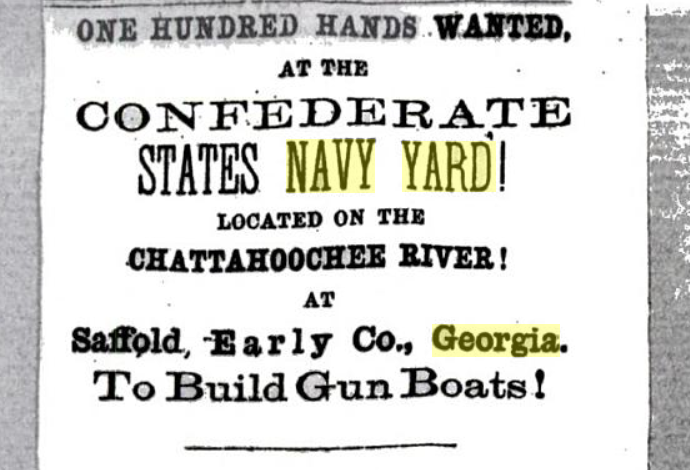
Realizing skilled workers were needed for certain aspects of the ship's design Johnston placed an ad in the Columbus Daily Sun touting "steady employment and good wages for ship carpenters, joiners, caulkers", etc.


To further entice folks a line at the bottom of the ad said, "All hands employed at the Confederate States Naval Yard are exempt from military duty and anyone in the army can be furloughed to work there."

Navy officers also began suspecting Johnston was using the yard at Saffold for personal business rather than completing the contract, so a strict timetable was put into place.

Finally, ten months past the original deadline the CSS Chattahoochee was delivered on December 8, 1862.

It's clear that originally the Confederate Navy had great plans for the Chattahoochee based on the fact that Lt. Catesby ap Roger Jones was chosen to command the gunboat. Jones had become a famous southern hero when he commanded the CSS Virginia (Merrimac) against the USS Monitor. In case you are wondering.....the "ap" in Jones' name is Welsh meaning "son of".

The Chattahoochee was finally launched in February, 1863. Unfortunately, it ran aground and seriously damaged its hull its first day out.

By the time it was ready to go again the Confederates had sunk obstructions in the Apalachicola River to keep Union ships from venturing up the river. Those same obstructions dashed the hopes of the Chattahoochee's crew from engaging the enemy. During most of 1863, the ship remained  above the obstructions basically serving as a glorified gun battery occasionally holding drills, but that's about it.

It was safe duty, but also boring duty.

Jones moved on to another post and Lt. J.J. Guthrie took command. In late May, 1863 the Chattahoochee steamed down the Apalachicola to aid the schooner Fashion that had taken on cotton and was planning to run the blockade. It had been captured by the Union below the obstructions, but many historians believe Lt. Guthrie intended on ramming the obstructions, but many historians believe Lt. Guthrie intended on ramming the obstructions to give the Fashion assistance.

This site advises further:

Tragically, neither the captain nor his crew knew that a severe early season hurricane was about to move in from the Gulf. The wind and rain increased through the night and by the morning of May 27, 1863 when Guthrie returned, the vessel was already feeling the brunt of the approaching storm. These conditions probably contributed greatly to what happened next. As the crew prepared to raise steam for the trip upriver, an argument broke out over how much water was in the boiler. Reportedly, a gauge was not working and before the ship's chief engineer could intervene, a massive steam explosion rocked the vessel.

It is widely believed this malfunctioning gauge caused the crew to unknowingly allow the boiler to grow red hot before filling it with water. When water poured in hitting the red hot metal casing, it instantly vaporized and burst through various sections of piping attached to the boiler. Sixteen members of the crew were killed within minutes, through being scalded by the steam. Another was mortally injured from a large lump of flying metal ripping upwards through the deck. Two more men were severely wounded and another four received minor injuries. Panicked into believing the ship's gunpowder store adjacent to the magazines might explode, the remaining crew opened plugs in the ship's hull and let her sink to the bottom of the muddy river. Descriptions of what conditions on the deck of the Chattahoochee were like vary; but most confirm a total loss of order by her officers, with men running about frantic with fear and in pain from their wounds. Many jumped overboard and at least three bodies were recovered downstream some days later. The dead and wounded were eventually taken ashore despite an increasing and raging storm.....The ship was quickly recovered and towed upriver to Columbus where she was again refitted.

Refitted again?

Yes, but again the ship didn't see any service. As the Union gained ground in April, 1864 and got closer to Columbus the crew of the Chattahoochee sank their ship in the Chattahoochee River to prevent its capture by the Union.

It would be one hundred years before the ship saw the sunlight again when it was located and raised. 


Part of the hull and the original steam engines are on display at the National Civil War Naval Museum in Columbus, Georgia.

Yes! Columbus, Georgia has a naval museum....

Instead of blowing through the town on my way to Florida next time, I think we need to spend the night and investigate Columbus a little.
Related Posts Plugin for WordPress, Blogger...