Here's a big HELLO to those of you who might find yourself here through a Google search, or you are a long-time subscriber to this site via Feedburner and/or RSS Feed.
I've moved!
I'd love to have you visit me at my own domain where I come out from behind the ElementaryHistoryTeacher name, but continue to share the stories behind the history.
Unfortunately, I couldn't take my current subscription list to the new site. You will have to join my new mailing list to receive information regarding blog updates, new books as they are published including my own brand of history curriculum for educators.
My teaching memoir will be published in 2016 along with the first of my curriculum units.
The new website, LisaLandCooper.com is up and running!
Come on over, have a look around, and introduce (or reintroduce in some cases) yourself by leaving a comment or sending me a message.
Feel free to "like" one or all of my pages on Facebook, too!
History Is Elementary - for history teachers and anyone who enjoys history and history education
Georgia on My Mind - for those who love Georgia history with an occasional travel or opinion piece thrown in here and there
Every Now and Then - focusing on the history of Douglas/old Campbell County, Georgia
All three pages contain hundreds of vintage images with new ones being added daily!
Monday, April 20, 2015
Monday, August 18, 2014
Finally! I've Written a Book!
I've written and published a book!
Of course, that was my intention when I began writing online way back in 2006 while I was still in the classroom, but the book I've published isn't exactly the book I had planned.
The planned project - a teaching memoir - will still be published along with a few other projects, but this book feel into my lap along the way, and it needed to be done.
History education is my prime focus along with writing curriculum. Over the last couple of years I've written some college courses used by teacher candidates at Johns Hopkins University School of Education, and I have some other curriculum ideas up my sleeve, but local history has taken a front-burner position over the last year.
I've been researching and writing the local history of Douglas County for the past four years, and have had a weekly column with the Douglas County Sentinel for a year and half.
I've been a longtime fan of the Images of America series of books from Arcadia Publishing. Several towns in Georgia are included, but my town of Douglasville was missing.
When Arcadia contacted me last year, there was no other alternative than to sign the contract and get busy. The book was released July 14th, and I'm very proud of it.
The book contains 200 vintage images depicting the history of Douglasville, Georgia with some dating back to the 1870s and covering the next one hundred years.
As far as a southern town goes, Douglasville is a bit unique as it IS the quintessential New South town having been birthed in 1875 during Reconstruction.
You can see a Google preview of the book HERE, and you can purchase it via Amazon HERE
.
Of course, that was my intention when I began writing online way back in 2006 while I was still in the classroom, but the book I've published isn't exactly the book I had planned.
The planned project - a teaching memoir - will still be published along with a few other projects, but this book feel into my lap along the way, and it needed to be done.
History education is my prime focus along with writing curriculum. Over the last couple of years I've written some college courses used by teacher candidates at Johns Hopkins University School of Education, and I have some other curriculum ideas up my sleeve, but local history has taken a front-burner position over the last year.
I've been researching and writing the local history of Douglas County for the past four years, and have had a weekly column with the Douglas County Sentinel for a year and half.
I've been a longtime fan of the Images of America series of books from Arcadia Publishing. Several towns in Georgia are included, but my town of Douglasville was missing.
When Arcadia contacted me last year, there was no other alternative than to sign the contract and get busy. The book was released July 14th, and I'm very proud of it.
The book contains 200 vintage images depicting the history of Douglasville, Georgia with some dating back to the 1870s and covering the next one hundred years.
As far as a southern town goes, Douglasville is a bit unique as it IS the quintessential New South town having been birthed in 1875 during Reconstruction.
You can see a Google preview of the book HERE, and you can purchase it via Amazon HERE
Labels:
Douglas County,
Douglasville,
New South,
Personal,
Reconstruction
Monday, January 27, 2014
The Murder of Sarah Collins
When thinking about past events it is easy to speed up time. For example, several events occurring over a few weeks can be interpreted in just a few days especially once they hit the movie screen.
Atlanta's involvement in the Civil War is one such example,
and I blame the movie….not the book….Gone with the Wind for the
"speedy" version most people have in their minds.
We see Aunt Pittypat upset because Yankees have reached
Georgia as she is evacuating the city. The Battle of Atlanta occurs, Miss Melly
has her baby and that scoundrel Sherman burns the town.
What a day!
However, those events occurred over several weeks.
The Battle of Atlanta occurred on July 22, 1864 with the
Rebels retreating from the city.
The Mayor of Atlanta didn't surrender the city to the Union
until September 2, 1864 following a five week siege.
Five long weeks….
While there were some heart wrenching events during those
weeks of siege many folks in the city of Atlanta tried to get on with some
semblance of normalcy.
In his book, The
Bonfire: The Siege and Burning of Atlanta, Marc Josef Wortman states,
"Thumbing their collective rebel noses at Sherman amid the siege,
Atlanta's party life went blithely on. Distillers sold corn whiskey to
soldiers, and prostitutes serviced the troops behind the lines. Officers went
to festive balls, where bands played while fiery exploding shells passed
overhead."
One such ball was given by the Atlanta Medical College on
August 12, 1864 just twenty-one days after the Battle of Atlanta.
The Atlanta Medical College would eventually become Emory
University's School of Medicine. The picture I've posted above is the school as it appeared in 1957. This image is a drawing that appeared in the Illustrated History of Atlanta by Edward Young Clarke.I'm uncertain as to why the school decided to give a ball during the siege of Atlanta since they had suspended lectures on July 3rd, but they did.
One of the young ladies who attended the ball happened to be
Sarah Collins, a woman described as beautiful and held a "high position in
the first circles of the city."
Sarah had arrived in Atlanta a year earlier as a refugee
from Memphis.
The Medical College ball would be her last event.
In the midst of war in a city that was under siege, Sarah
was murdered.
The newspaper at the time....the Daily Intelligencer reported the murder of Sarah Collins describing
the event as "the most horrible crime that has ever been committed in [the
city of Atlanta]." She was found strangled in her bed. The Daily Intelligencer reported "her
throat was perfectly black where she had been choked, her arms were bruised,
and her body terribly mutilated; her clothing was torn and muddy as though she
had been drug through the mud by some villain who had violated her
person."
Unfortunately, due to the chaos of the times with no real
law enforcement no one was ever brought to justice for the murder of Sarah
Collins.
To my knowledge the murder remains an unsolved crime with
very little written about it other than the article that appeared in the Daily Intelligencer during August, 1864
and a mention here and there in various books.
Monday, January 20, 2014
Atlanta by Gaslight
People lament all the time that the old Atlanta is gone –
torn down, built over, swept away and forgotten.
We must remember that in the early days, natural gas had
not yet been harnessed for energy purposes. The plant Helme proposed to build
would be one that burned coal in order to produce the gas.
You can view pictures of one of the three Piedmont
Park lamps mentioned above at History Atlanta, one of my new blog finds that I
ADORE here. Fantastic site and great
scholarly research!
I think the past is still with us in a tangible way such
as the Tullie Smith house or the Wren’s Nest, but yes – sometimes we do have to
be satisfied with historical memories via the written word or images presenting
places long gone like the grand mansions that lined Peachtree Street once upon
a time.
Then there ARE those situations where bits and pieces
remain.
I find those fragments of history to be the most
fascinating because they hide in the contemporary landscape with most never
realizing they are passing a gateway to Atlanta’s past each and every day.
Take the three streetlights that stand in Piedmont Park near Park Drive Bridge, for example.
The streetlights stand as a testament to Atlanta’s history
dating back to 1916 when the lights were placed in the park in remembrance of
the Gate City’s proud history.
That’s something isn’t it? Items still standing that date
back to 1916.
But wait – there’s more.
The light poles actually date to 1855 when they were
ordered from the Schofield Iron Works of Macon at a cost of twenty-one dollars
each. The granite bases for the three
poles were taken from some of the first pavement, or what existed as pavement,
at the time in the city.
Originally the poles were topped with gas lamps and were
installed along an Atlanta street by the Atlanta Gasworks. Today we know the company as the Atlanta Gas
Light Company, the oldest corporation in the city and second oldest in the
state.
Today’s news reports advise some of the streets in
Atlanta are dangerous at night, but in 1855 the reasons were very different.
Livestock roamed the streets and some of the pothole situations were described
as virtual pits that someone could stumble into if they were wandering around
in the dark.
The young city had been interested in the new technology
of gas lamps but cost was a factor. A couple of proposals were made for a city
gasworks, but the city council waited.
Finally, William E. Helme made his proposal. He was a
businessman from Philadelphia who had installed the gasworks for the city of
Augusta. He along with his partner, McIlhenny had patented gas meters and other
equipment. You can find out more about McIlhenny here.
Apparently, dabbling in the gas works industry was very
lucrative. This is the Helme home near Philadelphia in Lancaster, Pennsylvania. It sat on
eleven acres at Pike and St. David’s Road.
The plant would cost $50,000. His exclusive
contract was for a period of fifty years, and fifty street lamps would be
provided initially at $30 per annum.
Helme set to work laying the first three miles of pipe
for the gas. Atlanta's citizens celebrated on December 25, 1855 when the first gas lamps
were lit.
The gasworks company and the shareholders earned handsome
dividends over time.
During the Civil War the city took over the company.
Since Helme and many of the shareholders were Northerners, they were declared “alien
enemies”. The seized shares were soon auctioned off to folks of the Confederate
persuasion.
However, Helme and his investors weren’t the Yankees the
city council should have been concerned with since it was General Sherman who
ordered the Gas Works to be burned in 1864.
Following the war it took a while, but by 1880 all of the
city’s lamps were lit again, and by 1881 the city converted all 426 gas lamps
into electric ones.
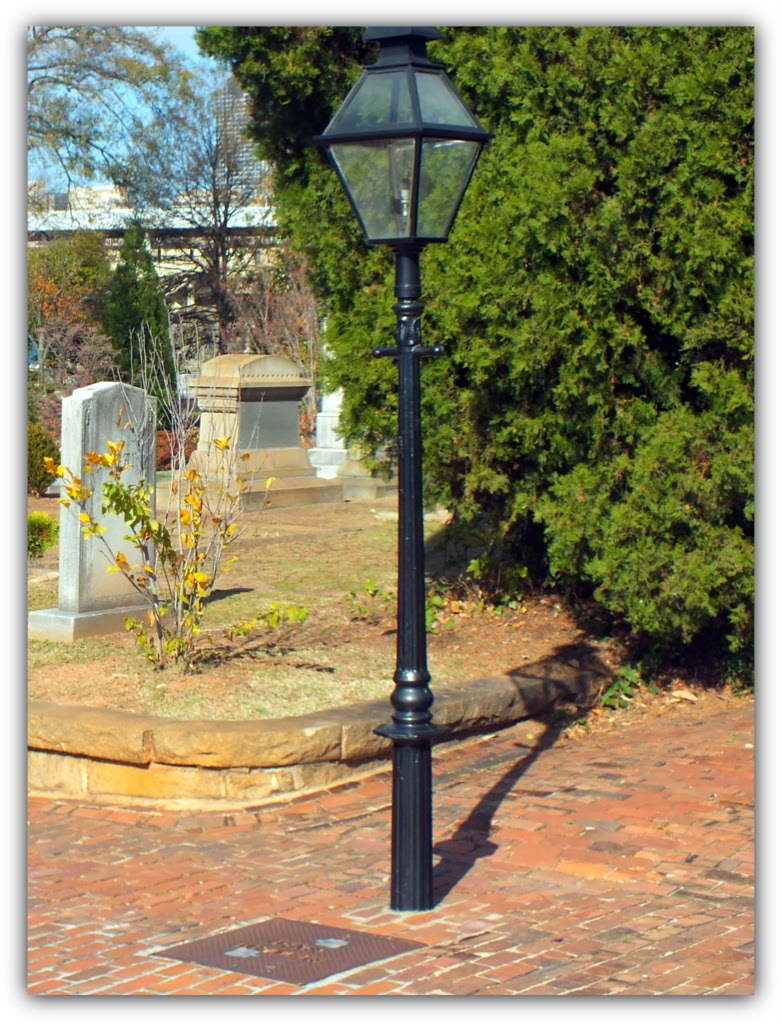
One of the lamp posts can be seen at Oakland Cemetery as
seen below (photo credit: Robert Lz/Flicker)
Tuesday, January 14, 2014
Georgia History: New and Soon to be available titles from Arcadia Publishing
Arcadia Publishing has recently announced two new titles in their Images of America series focusing on the towns of Smyrna and Stone Mountain.
The Images of America series are unique in that they tell the history of small towns and downtown areas through vintage pictures with informative captions. The Arcadia website states, "Local authors transform dusty albums and artifacts into meaningful walks down memory lane. Millions of vintage images become tiny time capsules, re-establishing memories of the formerly familiar, introducing generations to what once was, and reminding us all of what has been (and can be) in every corner of our nation. The popular series has expanded over to time preserve and celebrate additional worthy topics including local landmarks, architecture, ethnic groups, and more."
The city of Smyrna dates back as far as the 1830s getting its start as a religious campground. The book "Smyrna" (the cover image is provided below) traces the town's history through several events including Civil War battles, the growth stemming from US 41, and the impact of Bell Aircraft Corporation (Lockheed). The book was put together by Harold Lee Smith, a co-founder of the Smyrna Historical and Genealogical Society, Inc. and the Smyrna History Museum. He's also a former city council member and Smyrna mayor. Mr. Smith's co-author is Kara Hunter-Oden, a curator of the Smyrna History Museum and vice president of the Smyrna Historical and Genealogical Society, Inc.
This spring, Arcadia Publishing will be announcing other new titles for Georgia including MINE.
Yes! My Images of America volume titled "Douglasville" will be ready for purchase by May, 2014!
Stay tuned for more information.
Hundred of history enthusiasts across the nation actually collect the Images of America series, and Arcadia makes collecting and purchasing easy.
You can search for and purchase titles directly from the Arcadia website, and easy to use social media buttons make it easy for you to alert friends and family concerning your favorite volumes. They even provide a few pages for you to review titles before you purchase via Google Preview.
If you sign up for the Arcadia newsletter, you will receive 20% off your next purchase.
HINT: You can use the discount to purchase MY book!
The Smyrna volume can be reviewed and purchased here.
The Stone Mountain volume can be reviewed and purchased here.
I can't wait for my copies of "Smyrna" and "Stone Mountain" to arrive, but I have to be honest - I'm really getting excited about the release of my own title.
I'm so ready to share it!
The Images of America series are unique in that they tell the history of small towns and downtown areas through vintage pictures with informative captions. The Arcadia website states, "Local authors transform dusty albums and artifacts into meaningful walks down memory lane. Millions of vintage images become tiny time capsules, re-establishing memories of the formerly familiar, introducing generations to what once was, and reminding us all of what has been (and can be) in every corner of our nation. The popular series has expanded over to time preserve and celebrate additional worthy topics including local landmarks, architecture, ethnic groups, and more."
The city of Smyrna dates back as far as the 1830s getting its start as a religious campground. The book "Smyrna" (the cover image is provided below) traces the town's history through several events including Civil War battles, the growth stemming from US 41, and the impact of Bell Aircraft Corporation (Lockheed). The book was put together by Harold Lee Smith, a co-founder of the Smyrna Historical and Genealogical Society, Inc. and the Smyrna History Museum. He's also a former city council member and Smyrna mayor. Mr. Smith's co-author is Kara Hunter-Oden, a curator of the Smyrna History Museum and vice president of the Smyrna Historical and Genealogical Society, Inc.
Who doesn't know about Georgia's iconic Stone Mountain, but what do we really know about the community of the same name? The new Arcadia volume titled "Stone Mountain" ( the cover image is seen below) provides a fantastic chance to learn about the "village that developed in its shadow". Who knew that "a flourishing granite industry attracted skilled, European laborers" or that following the Civil War the neighborhood of Shermantown was established by former slaves? The book was put together by the Stone Mountain Historical Society.
Yes! My Images of America volume titled "Douglasville" will be ready for purchase by May, 2014!
Stay tuned for more information.
Hundred of history enthusiasts across the nation actually collect the Images of America series, and Arcadia makes collecting and purchasing easy.
You can search for and purchase titles directly from the Arcadia website, and easy to use social media buttons make it easy for you to alert friends and family concerning your favorite volumes. They even provide a few pages for you to review titles before you purchase via Google Preview.
If you sign up for the Arcadia newsletter, you will receive 20% off your next purchase.
HINT: You can use the discount to purchase MY book!
The Smyrna volume can be reviewed and purchased here.
The Stone Mountain volume can be reviewed and purchased here.
I can't wait for my copies of "Smyrna" and "Stone Mountain" to arrive, but I have to be honest - I'm really getting excited about the release of my own title.
I'm so ready to share it!
Labels:
Arcadia Publishing,
Douglasville,
Smyrna,
Stone Mountain
Monday, January 6, 2014
13 Things About King George II
The colony of Georgia was named to honor King George II. This list of 13 things concerning his life is by no means complete, but is a list of things I found to be highlights of interest.
Picture credit: Portrait of George II, 1730 by Enoch Seeman via WIkipedia
1. Georgia was the thirteenth and final colony set up by
Great Britain in 1733. Since it was formed during the reign of King George II
it makes sense that the colony was named for him. What a great way to get his attention!
2. King George II wasn’t just the King of Great
Britain. His official title was King of
Great Britain and Ireland, Duke of Brunswick-Lüneburg (Hanover), and Prince
elector of the Holy Roman Empire. Brunswick-Lüneburg was a historical ducal state dating to
the late Middle Ages and was the principal home for George II and his father
before him, George I.
3. As a Prince elector of the Holy Roman Empire, George II
was a member of the Electoral College that had the privilege of electing the
King of the Romans/Holy Roman Emperor.
When thinking of the Holy Roman Empire, think primarily about Germany
and Italy. After existing for hundreds of years the title was phased out in the
early 1800s. I could launch off into an exhausting history side-bar here....but I won't, and you're welcome.
4. King George II was the last British monarch to have been
born outside Great Britain. Yes, it
seems strange that a German born prince born in the German city of Hanover took
the British throne. Basically, it was
due to his grandmother, Sophia of Hanover and an act of Parliament. The Act of Settlement in 1701 restricted
Catholics from taking the throne throwing Sophia of Hanover several steps up
the line of succession and resulting in George II’s father, George I taking the
throne in 1714.
5. George II had little power. By 1729, Parliament
controlled domestic and foreign policy in Great Britain, but George II still
managed to influence affairs. He
actually had more power in Hanover, and spent many summers there overseeing
things. You can't blame the guy....
6. George II married Caroline of Ansbach in 1705. He
actually visited the Ansbach court under a false identify so he could check
Caroline out to make sure she would be a suitable bride. Apparently, she passed muster since they had
many children over the years. Still ,
his high regard for Caroline did not keep George II from having mistresses.
It’s good to be the King, right?
In fact, on her death bed Caroline implored the King to remarry. He told her no, but he would have
mistresses.
Nice, huh?
7. So, what’s a German Prince to do? It’s not like they can go down to the corner
and get a job at the drugstore or something.
While he was a king-in-waiting, George II wanted to lead men in battle
and do the whole “play soldier” thing.
His father flatly refused until a son and an heir were produced. After that little assignment was completed
the future George II participated in the Battle of Oudenarde in 1708. Say what you want to about prissy German
princes, but he had to have some bravery in him somewhere. His horse was shot out from underneath him
and the Colonel riding beside him was killed. It is said that the future king
bravely charged ahead of his troops, and in fact, George II is the last British king who led troops into battle.
Once George I was crowned King of Great Britain, the future
George II became Prince of Wales. At one point in 1716 his father returned to
Hanover to oversee matters of state there. The future George II was given
limited powers to govern in his father’s absence. He went on a tour of country through several
towns and the public was “allowed to see him dine at Hampton Court Palace.”
Can you imagine?
People showing up to gawk at you while you eat?
I guess it really is an uneasy head the crown rests on
because it was during this time an
attempt was made on his life at Drury Lane Theatre.
8. King George I died in 1727 and King George II finally
assumed the throne. To fully cement his place among the British people (since
some were still wary of their German kings) the new king decided not to travel
to Germany for his father’s funeral.
Folks saw it as a declaration of a firm commitment to Great
Britain. While it looked nice in
public, more than likely the real reason is through the years father and son
had quarreled over matters of state.
9. The charter creating the colony of Georgia was granted to
General James Oglethorpe on April 21, 1732. In the beginning Oglethorpe desired
a colony that would be a place where debtors could go. You might have even been taught that in
school, but while Oglethorpe wanted the colony to be a place where debtors
could find refuge and work their debts off free of prison, a debtor’s haven
never materialized.
That’s right. The
Georgia colony was NOT a haven for British debtors. King George II and his
advisors put a stop to that. Each of the 114 original settlers who sailed on
the Anne in 1733 was chosen for the
skills they could bring to the new colony, and there wasn’t a debtor among
them.
Instead, the King and other government officials liked the theory
that the newest colony could serve as a buffer zone between South Carolina and
lands to the south belonging to Spain.In order to serve as a “garrison province” that would defend the
southern colonies from invasion the new colony of Georgia would need to be
populated with strong folks willing to work hard.
In order to make sure the new Georgia citizens were on their
toes, Oglethorpe banned alcohol in the new colony as well as slavery. The men sent to the new colony were heavily
trained as members of the militia
10. While King George II did everything he could to prove to
the British people he was their king, he was also the Duke of Hanover. He returned there in 1736 to oversee
things. After an absence of several
months citizens attached a note to the gates of St. James’s Palace stating, “Lost
or strayed out of this house, a man who has left a wife and six children on the
parish.”
Well, at least the British had a sense of humor regarding
their absent king.
11. Just as King George II couldn’t get along with his
father, George I, he also couldn’t get along very well with his son and heir
Frederick. When Frederick, the Prince of
Wales applied to Parliament to increase his allowance, it caused a rift between
father and son. Feelings of ill will
were so high that when Frederick’s wife was about to give birth to the heir,
Frederick bundled her up, thrust her into a carriage and drove off in the
middle of the night to keep his parents from being present at the birth.
Frederick was banned from court after that.
12. Getting back to the colony of Georgia, ever hear of the
War of Jenkin’s Ear?
Britain and Spain went to war in 1739. Over in Europe the fracas became part of the
War of the Austrian Succession. As the
British monarch, King George II didn’t have much to say or do with the war, but
as the Elector of Hanover he could have a say and intervene directly in
European affairs, so he hightailed it to Hanover during the summers of 1740 and
1741 to participate more directly in the war.
As far as the colony of Georgia is concerned, colonists
attacked the Spanish city of St. Augustine in 1740 aided by a British naval
blockade, but were turned back. The British forces were led by James Oglethorpe.
They attempted to take the city of St. Augustine for over a month before
retreating. They finally just gave up. The Georgia colonists simply walked away
from their artillery.
13. Following the approval of the Colony of Georgia’s charter
the council of Trustees governed the colony deciding how subsidies received
from Parliament would be allocated.
Running a colony where everyone has different agendas is more difficult
that it seems. Oglethorpe finally
returned home for the last time.
On June 23, 1752, the Trustees submitted a deed of reconveyance
to the crown and three years later the colony ceased to be a proprietary colony
and became a crown colony. It remained that way until the American Revolution.
King George II died in October, 1760 leaving the throne in
the hands of his grandson, George. At
the time of his death the king was blind in one eye and could barely hear. It was determined he died from an aortic
aneurysm.
He was buried in Westminster Abbey next to his wife. It’s
interesting to note that he had left instructions for his coffin and that of
his wife to have the sides removed so that their remains could mix together.Picture credit: Portrait of George II, 1730 by Enoch Seeman via WIkipedia
Wednesday, November 6, 2013
The Confederate Rosie the Riveter
One of the iconic images of World War II happens to be Rosie the Riveter representing thousands of women who entered the work force at a time when the majority of Americans felt a woman's place was at home. Conditions were often harsh, pay was not equal, and most had to deal with unfavorable treatment by men working beside them.
It took a strong woman to become "Rosie the Riveter".
It took a fighter.
One Georgia native - Helen Dortch Longstreet - was a fighter. In fact, over and over during her life she had earned the nickname "fighting lady".
In 1894, she was appointed assistant state librarian - the very first woman in Georgia to hold that position. In 1896, the Dortch Bill passed the state legislature. It was named for Helen Dortch Longstreet and paved the way for any woman to be able to hold state office.
In 1897, Helen met General James Longstreet through her college roommate. He was 76. She was 34. The same year the General was busy with Chancellorsville and Gettysburg, Helen was born!
Though they were only together for six years before General Longstreet died, it must have been a very special relationship. Found among Helen's papers stored at the Atlanta History Center you can find an unpublished essay written by Helen that details their courtship titled Wooed to the Warrior's Tent.
Wooed? Why General Longstreet! I do declare!
I really need to get to the Atlanta History Center and look through Helen's papers.
After the marriage, Helen took on the job as postmistress in Gainesville, a post she held though 1913. She also championed her husband's reputation as the controversial general who failed to follow orders at Gettysburg. She fought until the end of the General's life and then her own to portray his life correctly in history. In 1905, Helen published Lee and Longstreet at High Tide to that end.
In 1911, Helen fought unsuccessfully with Georgia Power over their wish to build hydroelectric dams along the Tallulah River citing that no one knew for sure what the impact the dams would have on the river or to Tallulah Gorge. Her fight is considered to be one of the first efforts at conservation in Georgia.
During World War II at the age of 80, Helen Dortch Longstreet packed a lunch, picked up her tools, and stood alongside other Georgia women at Bell Bomber (Lockheed) building B-29s. Life magazine featured Helen in their issue dated December 27, 1943 as the "Confederate General's Widow". The picture below appeared in Life.
During the 1950s, Helen Dortch Longstreet led an unsuccessful write-in campaign against Herman Talmadge for governor.
Think of that! A woman running for governor in the 1950s, even if it was a write-in campaign. Helen was most certainly a woman before her time.
Another first for Helen involved her portrait hanging at the state capitol building in Atlanta. Yes, hers was the first portrait to hang alongside important men throughout Georgia's history.
Several resources state Helen Dortch Longstreet was, at the time of her death, the last surviving widow of a Confederate General. It's hard to know for sure since records weren't kept very well on the Confederate side. One thing can't be disputed - Georgia did have a Confederate Rosie the Riveter, and she knew how to fight for issues she believed in.
It took a strong woman to become "Rosie the Riveter".
It took a fighter.
One Georgia native - Helen Dortch Longstreet - was a fighter. In fact, over and over during her life she had earned the nickname "fighting lady".
In 1894, she was appointed assistant state librarian - the very first woman in Georgia to hold that position. In 1896, the Dortch Bill passed the state legislature. It was named for Helen Dortch Longstreet and paved the way for any woman to be able to hold state office.
In 1897, Helen met General James Longstreet through her college roommate. He was 76. She was 34. The same year the General was busy with Chancellorsville and Gettysburg, Helen was born!
Though they were only together for six years before General Longstreet died, it must have been a very special relationship. Found among Helen's papers stored at the Atlanta History Center you can find an unpublished essay written by Helen that details their courtship titled Wooed to the Warrior's Tent.
Wooed? Why General Longstreet! I do declare!
I really need to get to the Atlanta History Center and look through Helen's papers.
After the marriage, Helen took on the job as postmistress in Gainesville, a post she held though 1913. She also championed her husband's reputation as the controversial general who failed to follow orders at Gettysburg. She fought until the end of the General's life and then her own to portray his life correctly in history. In 1905, Helen published Lee and Longstreet at High Tide to that end.
In 1911, Helen fought unsuccessfully with Georgia Power over their wish to build hydroelectric dams along the Tallulah River citing that no one knew for sure what the impact the dams would have on the river or to Tallulah Gorge. Her fight is considered to be one of the first efforts at conservation in Georgia.
During World War II at the age of 80, Helen Dortch Longstreet packed a lunch, picked up her tools, and stood alongside other Georgia women at Bell Bomber (Lockheed) building B-29s. Life magazine featured Helen in their issue dated December 27, 1943 as the "Confederate General's Widow". The picture below appeared in Life.
During the 1950s, Helen Dortch Longstreet led an unsuccessful write-in campaign against Herman Talmadge for governor.
Think of that! A woman running for governor in the 1950s, even if it was a write-in campaign. Helen was most certainly a woman before her time.
Another first for Helen involved her portrait hanging at the state capitol building in Atlanta. Yes, hers was the first portrait to hang alongside important men throughout Georgia's history.
Several resources state Helen Dortch Longstreet was, at the time of her death, the last surviving widow of a Confederate General. It's hard to know for sure since records weren't kept very well on the Confederate side. One thing can't be disputed - Georgia did have a Confederate Rosie the Riveter, and she knew how to fight for issues she believed in.
Monday, October 7, 2013
Palmetto's Railroad Depot Museum
By the time I was aware of the Atlanta and West Point Railroad depot buildings they were all but abandoned since the railroad no longer used them by the mid-1960s.
Red Oak's depot was moved to another location. I'm sure the depot in College Park was used for something, but I can't remember. I do remember a law firm making their home in Fairburn's depot (it's still there), and the city of Palmetto used their depot for city offices including the police department.
The other day as I was heading through Palmetto I noticed they had opened a museum in their depot.
I decided to take a few minutes and stop. I'm glad I did. The docent and I had a lovely time sharing history.
Palmetto's depot was built somewhere between 1914 and 1917 with plenty of room for freight on one side of the building and passengers on the other. At the time the depot was built, the rails through Palmetto didn't set up as high as they do now. In fact, they dipped down to the point that sometimes the train would get stuck and an engine would be dispatched to come behind the train to "push" it along. The passengers would disembark and then have to come through a small tunnel underneath the depot and climb the steps to reach the passenger waiting room.
Once the depot was no longer needed for rail travel the city managed to rent it from CSX Railroad for $100 a year. The sweet deal came to fruition because a former mayor was a CSX employee.
When the city moved out the building sat, and like so many older beauties, it began to decay. Many thought it just needed to be torn down. After all...the roof had holes in it, and there was an asbestos issue.
You can see the depot agent's office, the original ticket window and all the doors and windows are original to the property. There is also a train-side deck/patio.
Of course, for some folks the word "train" in the official name of the museum is confusing since the focus is Palmetto's history and NOT trains. There are no trains featured in the historical exhibits, but they DO cover Palmetto's history with new things being added all the time.
The museum is in the middle section of the depot with the brick walls lined with vintage furniture, objects, clothing and other memorabilia.
The museum also owns a vast collection of historic photographs.
A couple of penny-farthing bikes donated by former Palmetto mayor, Robert Steed are on display. A penny-farthing bike gets its name from the high wheel/small wheel that resembles a British penny next to a farthing.
Take some time and learn some local history. The Palmetto Train Depot Museum located at 549 Main Street (Highway 29/Roosevelt Highway) is open on Tuesdays and Thursdays from 10 a.m. until 2 p.m. with free admission.
Visit Georgia on my Mind's Facebook page here to see more of my pictures from my visit to the museum.
You can see pictures from Palmetto's official grand opening here....
Red Oak's depot was moved to another location. I'm sure the depot in College Park was used for something, but I can't remember. I do remember a law firm making their home in Fairburn's depot (it's still there), and the city of Palmetto used their depot for city offices including the police department.
The other day as I was heading through Palmetto I noticed they had opened a museum in their depot.
I decided to take a few minutes and stop. I'm glad I did. The docent and I had a lovely time sharing history.
Palmetto's depot was built somewhere between 1914 and 1917 with plenty of room for freight on one side of the building and passengers on the other. At the time the depot was built, the rails through Palmetto didn't set up as high as they do now. In fact, they dipped down to the point that sometimes the train would get stuck and an engine would be dispatched to come behind the train to "push" it along. The passengers would disembark and then have to come through a small tunnel underneath the depot and climb the steps to reach the passenger waiting room.
Once the depot was no longer needed for rail travel the city managed to rent it from CSX Railroad for $100 a year. The sweet deal came to fruition because a former mayor was a CSX employee.
When the city moved out the building sat, and like so many older beauties, it began to decay. Many thought it just needed to be torn down. After all...the roof had holes in it, and there was an asbestos issue.
Thankfully, in the year 2000 the railroad sold the depot to the city for $14,000. Once the deed was in the city's name, a group of historically minded citizens applied for a couple of grants. One in particular was a Georgia Transportation grant for $1.2 million dollars with an 80/20 split. The city would have to contribute 20 percent of the money used to restore the depot, but the majority of funds would be given. A second grant was obtained for $200,000.
Eighteen months later and just one year ago, a ribbon cutting celebration was given, and there was quite a bit to show off.
The restored depot houses a conference room at one end and space for special events on the other end. The special events section of the depot has the original depot flooring including the original freight scale embedded in the floor.
Of course, for some folks the word "train" in the official name of the museum is confusing since the focus is Palmetto's history and NOT trains. There are no trains featured in the historical exhibits, but they DO cover Palmetto's history with new things being added all the time.
The museum is in the middle section of the depot with the brick walls lined with vintage furniture, objects, clothing and other memorabilia.
The museum also owns a vast collection of historic photographs.
A couple of penny-farthing bikes donated by former Palmetto mayor, Robert Steed are on display. A penny-farthing bike gets its name from the high wheel/small wheel that resembles a British penny next to a farthing.
Take some time and learn some local history. The Palmetto Train Depot Museum located at 549 Main Street (Highway 29/Roosevelt Highway) is open on Tuesdays and Thursdays from 10 a.m. until 2 p.m. with free admission.
Visit Georgia on my Mind's Facebook page here to see more of my pictures from my visit to the museum.
You can see pictures from Palmetto's official grand opening here....
Tuesday, September 10, 2013
Georgia's Bedspread Alley

Are you on Pinterest? I have an account, but my four or five little boards
there are awfully lonely.
I’ve ignored Pinterest on purpose.
I’m afraid once I dive in there will be no saving me, and
I’ll spend too much of my time scrolling through the pretty images and forget
more pressing matters.
Every now and then I get a notification that someone new
is following my boards. I feel so bad and want to send them an apology letter
letting them know that one day…someday… my Pinterest boards will be more interesting.
I most certainly see the value of Pinterest just from the
pins that roll across my newsfeed on Facebook.
I see things I could forward to others...I saw this and
thought it might interest you…
Ideas that I could use thinking to myself...Oh, that
would be perfect for the bedroom.
All sorts of craft ideas that make me dream...Yes! I
can make that, too. I’ll try that…,
and then I laugh myself right out of the thought minutes later since I’m not
very crafty as in glue and thread kind of “crafty”.In 1892, when she was 15, Catherine Evans didn’t have Pinterest, of course, but she did see something she wanted to try. She saw a tufted bedspread someone had made prior to the Civil War. Catherine decided she wanted to try the technique.
She took a bodkin needle, a blunt needle used for pulling
something large through a piece of material, and tried her hand at tufting. The
tufts were made by pulling eight threads at a time through the material. Over
and over the threads would be pulled until the design was complete. Once the
fabric was washed and dried the tufts would be there to stay.
What began as a personal challenge to see if she could
recreate something turned into something she did over and over for family and
friends finally selling one for $2.50.
That’s where the story really takes off economically not
only for Catherine, but for nearly 10,000 women and their families across North
Georgia.
You see, after that first sale the orders just kept
coming. More and more folks were recruited to complete the tufting.
A cottage industry was born!
Gradually over time men were hired to work in stamping
facilities where the designs were made on plain white sheeting. There were various methods used to stamp the
fabric, but one way was to lay a plain
piece of sheeting over a completed tufted spread.
Blocks of melted paraffin with bluing would be rubbed
across it. The tufting underneath would leave marks and form a pattern to
follow.
Sheeting stamped with designs would be delivered to homes
where the women would complete the tufting. Once the design was complete the
sheeting would be washing in hot water shrinking the fabric which in turn would
hold the threads in place. The sheeting would be tossed over the clothes lines
for drying which helped the tufting to “fluff”.
Hanging the sheeting over the clotheslines with the
bright colors and interesting designs was also a great way to advertise the
bedspreads, and fairly soon the route down Highway 41 between Cartersville and
Dalton became known as “Bedspread Alley”.
Eventually, real manufacturing centers were set up while
the orders came in from all over the place.
There are stories though the ladies didn’t always wait for the orders to
arrive. Sometimes they would simply pack up 15 bedspreads along with an invoice
and mail them off to a northern department store. When the first invoice was paid without
question the ladies also received an additional order for more bedspreads. The process
was repeated over and over with department stores all over the place.
The demand for tufted items grew – house robes, rugs,
wall hangings, and house shoes.
If you’ve ever wondered how the Dalton area became
home to the carpet industry you only have to look back as far as the ladies who
made tufted or chenille bedspreads. The tufting process eventually led to wool
fibers being used with jute resulting in Dalton’s carpet industry.
Hmm, I wonder what I might find on Pinterest that could
be the next cottage industry in Georgia?You just never know….
Tuesday, September 3, 2013
College Park's Cox College
I wish I had a five dollar bill for every time I ventured
up Highway 29/Roosevelt Highway from Red Oak to downtown College Park. I’d have a tidy sum to invest.
To get the whole story regarding Cox College we need to
go back a little bit to 1842 when Pastor John E. Dawson organized LaGrange
Female Seminary. By 1854, the name
changed to Southern Female College. The campus was located close to the
intersection of Dawson and Seminary Streets. During the Civil War the school
was used as a hospital and unfortunately, was lost in a fire. A second building
was erected near Smith and Church Streets, but that building is also gone and
is now the location of a post office.
As you can see from these few pictures the young ladies
at Cox College enjoyed a beautiful campus. They had all of the modern conveniences at the turn-of-the
century including electric lights, steam heat, hot and cold water, baths, a
passenger elevator, tower clock, electric bells and speaking tubes per an ad in
Alkhest Magazine I found online.
The fine arts department had 46 pianos, a large pipe
organ, 2 Italian harps , an orchestral outfit, and art studios with flat models
and statuary.
From the age of four until I was around 20 years of age I
made that trip often…sometimes daily….sometimes two or three times a day
whether I was running errands with my mother or simply going back and forth to
school.
During all those years I didn’t give the history of
College Park any real notice. It’s where I hung out and lived. I was too busy going about the business of
growing up to be concerned with what might have happed on any given block.
Of course, once I entered the tenth grade and began to
have more rigorous history courses, and once I began attending Woodward Academy
– the former Georgia Military Academy – where history and tradition just seem
to ooze from every monument and brick, I couldn’t help but be interested.
For years the block along Main Street where College
Park’s city hall, library and what once was College Park High School seemed to
hold a secret – a secret of a past occupant due to the positioning of the lovely old trees. I could hear the secret
whispering to me as Mother and I would drive past. I’d look out of the window
and wonder what had once been there, but never had the time to really look into
the matter... though I heard rumors.
Who knew that back as early as the 1890s a very large and
well thought of female college was on that very property – a college known as
Cox College and Conservatory? The picture below shows the main building on
campus. This building faced Main Street, and this picture shows what they
called the Marble Entrance.
Ichabod F. Cox took over as president of the school in
1857. When he was ready to retire his son, Charles C. Cox took over, and in
1895 he moved the school to Manchester, Georgia. The Cox family had been in
charge of the school for so long that the name Cox was so strongly associated
with the school that eventually folks just referred to it as Cox College.
The folks in Manchester were happy about the arrival of
Cox College and welcomed the young ladies who attended. The people in Manchester were, according to
Robert Ballentine author of The Woodward Story, “very school-minded and
envisioned Manchester as an educational hinge in the southern area. By 1900,
the college had an enrollment of more than 300 young ladies and was
internationally known as an outstanding female school.”
Yes, the folks in Manchester were very school-minded, so
much so they changed the name of the town to reflect it. Beginning in 1896,
Manchester was known as College Park, Georgia.
Mr.Ballentine, who I remember fondly as my principal at Woodward Academy, writes
in his book about the day Colonel John Charles Woodward headed up to College
Park from his home in Newnan one spring morning in 1900 for a meeting about
another school the citizens of College Park wanted to form.
Woodward would have noticed the large and very impressive
structure of Cox College as he disembarked from the train and began walking up
Main Street to the White home (today’s College Park Women’s Club) where the
meeting would be held. Colonel Woodward
would have walked right by the college grounds and noticed how the campus
filled a “block and forty acres”.
Rachel Mays Dempsey advises in College Park Heritage (1958), "The
campus was covered with native hickory and oak trees...There were many
varieties of shrubs, hundreds of roses that bordered the walks and rows of
violets and beds of rhododendrons, azaleas and camellias…The campus outlined
with a low white wooden fence, was bordered on three sides by attractive homes
of the faculty.”
You can get an idea of what the campus was like in these
two pictures.
The inside of the school was just as luxurious for the
period. Here is a picture of the grand
staircase,
There was gymnasium space for tennis, and in infirmary
with an experienced nurse.
The library which I picture below contained 5,000
volumes. The school also boasted a
museum of natural history and industrial chemistry with over 7,000 specimens
and physical and chemical laboratories.
So much for thinking a young ladies finishing school was
simply about elocution lessons, right?
Charles C.Cox was known to boast, “A merely cheap school
is not the aim of the management of this institution; we are working for the
best in education, and are building with reference to the future.”
Getting back to the meeting Colonel Woodward attended in
College Park that day in 1900…He was meeting with a group of folks to discuss
the abandoned property where the Southern Military Academy had been
located. Charles Cox was a member of the
group along with Colonel P.H. Brewster, I.C. McCrory and others. At that meeting College Park’s second
academic center was formed as Colonel Woodward was persuaded to take over the
abandoned property, and the group became the original committee who established
Georgia Military Academy/Woodward Academy.
Cox College went on for several more years educating
hundreds of young ladies from across the South, however the school did close
several times between 1923 and 1933 due hard times.
Cox College closed their doors for the last time in 1938, and eventually the property became home to College Park's government complex.
You can find more pictures of this amazing place at my Facebook
page under “albums” here.
…and in case you aren’t aware Colonel Woodward did take
on the abandoned 16 acres. The abandoned building was renamed Founder’s Hall
and Georgia Military Academy embarked on their own rich history. Tuesday, August 27, 2013
A Confederate Courthouse
When we look at the Civil War era the war overshadows everything else. As a teacher I taught the causes, the battles and the aftermath, but generally due to time constraints I left something important out. I failed to teach about the life that went on during the war. I failed to teach about the folks back home. They still worked, planted their crops, shopped and went to school and church.
Life went on for county governments, too. In fact, two
Georgia counties managed to build courthouses during the war.
Brooks County is one of those counties. It was created in
1858 and named for Preston Brooks who is best known for beating Senator Charles
Sumner unconscious in 1856 due to his anti-slavery stance.
The folks in Brooks County decided to build a courthouse,
and apparently they had the money early on to build a very ornate building. Brooks
County historian Folks Huxford states, “The undertaking to build such a
pretentious and costly edifice in that day and time excited much surprise with
some of the citizens…especially in the adjoining counties most courthouses were
small affairs of rough timber and unpainted.”
County leaders hired John Wind, and English architect who
had been brought to nearby Thomasville by a wealthy planter to design their
courthouse and several large plantation homes including Susana. For his
troubles John Wind was paid one hundred dollars.There were challenges to build something so important during a time of war. There were shortages regarding skilled labor and materials, but later on county leaders were probably glad they proceeded with building a more expensive edifice.
You see, the original building was built entirely with
Confederate dollars - $14,958 to be exact.
Confederate dollars were bills of credit which means they
were backed not by tangible assets such as gold or silver but by a promise to
pay the bearer after the war. Of course, the promise was based on the
Confederate States of America winning the war, and we know how that turned out,
right? I’m fairly certain that Architect
Wind who was paid one hundred dollars for his design, didn’t hold onto his
Confederate pay. He probably spent it the next week as did most of the others
who received pay for the construction of the courthouse, but it is a little
unique fact I find interesting.
Due to shortages certain elements of Wind’s plan were
dropped. Historian Folks Huxford advises, “The parapet, cupola, balustrade on
the roof and certain ornate columns in the courtroom and porticos on the ends
of the building were dispensed with on account of the war.”
Unfortunately, we can’t get a true representation of what
Wind’s finished design looked like because the Brooks County Courthouse underwent
a major renovation in 1892. The picture I post here is the renovated building,
however sources state the original building bore a resemblance to Wind’s other
courthouse design in Thomas County which I’ve posted an image of below.
Subscribe to:
Posts (Atom)